


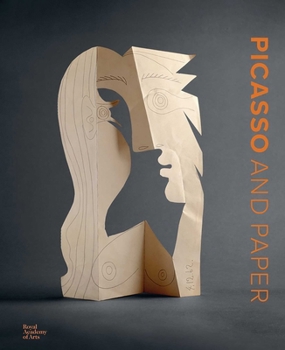
Picasso and Paper
No Customer Reviews

Pablo Picasso's artistic output is astonishing in its ambition and variety. This handsome publication examines a particular aspect of his legendary capacity for invention: his imaginative and original use of paper. Pablo Picasso's artistic output is astonishing in its ambition and variety. This handsome publication examines a particular aspect of his legendary capacity for invention: his imaginative and original use of paper. He used it as a support for autonomous works, including etchings, prints and drawings, as well as for his papier-coll experiments of the 1910s and his revolutionary three-dimensional 'constructions', made of cardboard, paper and string. Sometimes, his use of paper was simply determined by circumstance: in occupied Paris, where art supplies were hard to come by, he ripped up paper tablecloths to make works of art. And, of course, his works on paper comprise the preparatory stages of some of his very greatest paintings, among them Les Demoiselles d'Avignon (1907) and Guernica (1937). With reproductions of more than 300 works of art and additional texts by Violette Andres, Stephen Coppel, Emmanuelle Hincelin, Christopher Lloyd, Johan Popelard and Claustre Rafart Planas, this sumptuous study reveals the myriad ways in which Picasso's genius seized the potential of paper at different stages throughout his career.
Format:Paperback
Language:English
ISBN:1912520184
ISBN13:9781912520183
Release Date:May 2025
Publisher:Royal Academy of Arts
Length:328 Pages
Weight:3.45 lbs.
Dimensions:1.1" x 9.5" x 11.8"
Customer Reviews
0 rating
Copyright © 2026 Thriftbooks.com Terms of Use
| Privacy Policy | Do Not
Sell/Share My Personal Information | Cookie Policy | Cookie Preferences | Accessibility Statement
ThriftBooks® and the ThriftBooks® logo are registered trademarks of Thrift Books Global, LLC
ThriftBooks® and the ThriftBooks® logo are registered trademarks of Thrift Books Global, LLC
