


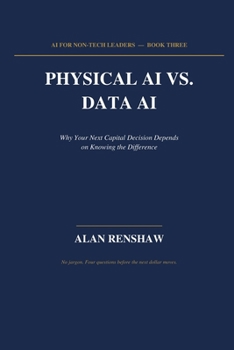
Physical AI vs. Data AI: Why Your Next Capital Decision Depends on Knowing the Difference
No Customer Reviews

Your next automation purchase could solve the wrong problem. Do you know which one you actually have? A manufacturer spends heavily on a robotic arm to fix what was actually a detection problem. A distribution company spends a year on smarter software for a bottleneck that was always physical. Neither system malfunctioned. Both companies simply answered the wrong question before spending the money, in opposite directions. Physical AI vs. Data AI is Book Three in the AI for Non-Tech Leaders series, built for the same non-technical readers as the first two: CEOs, plant heads, operations leaders, and anyone facing a capital decision about where AI actually belongs in their business, software or a physical system. This book gives you a plain-English way to tell the two apart before either mistake costs you money. Drawing on three decades inside some of the world's largest technology and infrastructure companies, author Alan Renshaw walks through four questions that determine whether a proposed AI investment, robotic or software, is actually worth the capital: what kind of problem you really have, what failure would cost, what true ownership actually costs beyond the purchase price, and whether you can test it cheaply before you commit. Inside, you'll learn: The plain-English test for telling a decision problem from a physical one, before you spend a dollarWhy a vendor's purchase price is never the true cost of a physical automation investmentThe humanoid robot trap: how an impressive demo can win a budget fight it shouldn'tWhat to ask any automation vendor before committing real capitalA complete, tear-out-ready capital audit built around four questions
This is not a book about robots or software in the abstract. It's a book about the specific, expensive mistakes that happen when leaders don't ask the right question before the money moves, and the four questions that would have stopped nearly every one of them. No jargon, no code: just four questions before your next AI dollar moves.
This is not a book about robots or software in the abstract. It's a book about the specific, expensive mistakes that happen when leaders don't ask the right question before the money moves, and the four questions that would have stopped nearly every one of them. No jargon, no code: just four questions before your next AI dollar moves.
Format:Paperback
Language:English
ISBN:B0HJLDGQQR
ISBN13:9798173572400
Release Date:September 2026
Publisher:Independently Published
Length:64 Pages
Weight:0.22 lbs.
Dimensions:0.1" x 6.0" x 9.0"
Customer Reviews
0 rating
Copyright © 2026 Thriftbooks.com
Terms of Use | Privacy Policy | Do Not Sell/Share My Personal Information | Cookie Notice | Cookie Preferences | Accessibility Statement
ThriftBooks ® and the ThriftBooks ® logo are registered trademarks of Thrift Books Global, LLC
ThriftBooks ® and the ThriftBooks ® logo are registered trademarks of Thrift Books Global, LLC
