


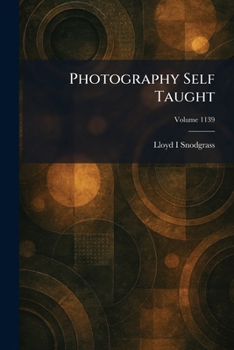
Photography Self Taught

"Photography Self Taught" is a comprehensive and accessible guide designed to introduce the art and science of photography to the amateur enthusiast. Written by Lloyd I. Snodgrass, this instructional manual breaks down the complexities of early 20th-century photographic techniques into manageable lessons suitable for self-study.
The work provides foundational knowledge on essential topics such as camera operation, exposure settings, and the chemistry involved in developing and printing photographs at home. Focusing on practical application, the text guides readers through the selection of equipment, the importance of lighting and composition, and the technical precision required for successful darkroom work. By demystifying the photographic process, "Photography Self Taught" empowers the reader to transition from a casual observer to a skilled practitioner.
This work serves as an invaluable historical resource for those interested in the evolution of photographic education and the democratization of the medium. Whether for the hobbyist or the student of technical history, Snodgrass's clear prose and structured approach offer a fascinating window into the world of film photography during a transformative era.
This work has been selected by scholars as being culturally important, and is part of the knowledge base of civilization as we know it. This work was reproduced from the original artifact, and remains as true to the original work as possible. Therefore, you may see the original copyright references, library stamps (as most of these works have been housed in our most important libraries around the world), and other notations in the work.
This work is in the public domain in the United States of America, and possibly other nations. Within the United States, you may freely copy and distribute this work, as no entity (individual or corporate) has a copyright on the body of the work.
As a reproduction of a historical artifact, this work may contain missing or blurred pages, poor pictures, errant marks, etc. Scholars believe, and we concur, that this work is important enough to be preserved, reproduced, and made generally available to the public. We appreciate your support of the preservation process, and thank you for being an important part of keeping this knowledge alive and relevant.
Customer Reviews
ThriftBooks ® and the ThriftBooks ® logo are registered trademarks of Thrift Books Global, LLC
