


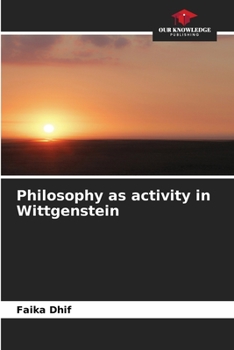
Philosophy as activity in Wittgenstein
No Customer Reviews

Our key question was: in what sense is Wittgensteinian philosophy defined as an activity in both the Tractatus and the post-Tractatus writings? In the Tractatus, philosophy is defined as the logical analysis of language. The essence of this activity is the elucidation of the common logical form of language, thought and the world. This activity is opposed to any form of scientific or philosophical theorizing, since it neither contributes anything nor represents anything. It is an activity of monstration of something formal and tautological, which is logical form. Moreover, in post-Tractatus writings, philosophy is seen as a movement of synoptic-phenomenological description of our ordinary language. It seeks to expose this limitless space of "forms of life" and our "language games". According to these two different interpretations of activity, Wittgenstein's philosophical conception goes beyond the generalizing penchant for knowledge that imprisons human thought in wooden blocks _ as Wittgenstein put it.
Format:Paperback
Language:English
ISBN:6206113574
ISBN13:9786206113577
Release Date:June 2023
Publisher:Our Knowledge Publishing
Length:60 Pages
Weight:0.22 lbs.
Dimensions:0.1" x 6.0" x 9.0"
Related Subjects
PhilosophyCustomer Reviews
0 rating
Copyright © 2026 Thriftbooks.com Terms of Use
| Privacy Policy | Do Not
Sell/Share My Personal Information | Cookie Policy | Cookie Preferences | Accessibility Statement
ThriftBooks® and the ThriftBooks® logo are registered trademarks of Thrift Books Global, LLC
ThriftBooks® and the ThriftBooks® logo are registered trademarks of Thrift Books Global, LLC
