


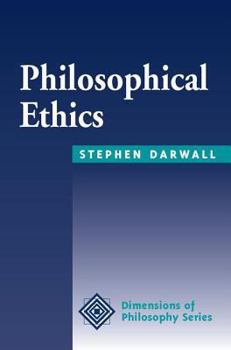
Philosophical Ethics: An Historical and Contemporary Introduction


Select Format
Select Condition 
Book Overview
This book shows how Hobbes, Mill, Kant, Aristotle, and Nietzsche all did ethical philosophy? It introduces students to ethics from a distinctively philosophical perspective, one that weaves together central ethical questions.
Format:Paperback
Language:English
ISBN:0813378605
ISBN13:9780813378602
Release Date:December 1997
Publisher:Routledge
Length:268 Pages
Weight:0.88 lbs.
Dimensions:0.6" x 5.7" x 9.1"
Customer Reviews
2 ratings
Learn from a leader in the field of ethics
Published by Thriftbooks.com User , 17 years ago
I read this book for a graduate seminar on Ethics. Stephen Darwall, one of the leading ethicists in philosophy today provides in his book "Philosophical Ethics" a great way to learn about the myriad field of ethics and morality. First, the book has a great glossary on the philosophical terms used in the field, this is invaluable! Second, Darwall sets up the various ethical schools of thought in the first have of the book, then in the second half, he explains the ideas of philosophical moralists; such as, Hobbes, Mill, Kant, Nietzsche, and Aristotle, in that order. This progression works well. Below is some of Darwall's explanation of the field of ethics, which will give the reader a sense of his writing style. Ethics is "moral philosophy," a major branch of philosophy, is the study of values and customs of a person or group. It covers the analysis and employment of concepts such as right and wrong, good and evil, and responsibility. It is divided into three primary areas: 1. Applied ethics (the study of the use of ethical values). 2. Ethical theory the "why" questions general and abstract principles that would let us separate right actions from wrong actions, good and bad character traits virtues, no sharp distinctions between applied ethics and ethical theory here. Both of these are known as: Normative ethics (the study of how to determine ethical values). 3.Meta-ethics (the study of the concept of ethics) comes out of metaphysics, and epistemology. Ethics has three parts, the most concrete is Applied Ethics: 1. Applied ethics Applied ethics is a discipline of philosophy that attempts to apply ethical theory to real-life situations. Such as business ethics, and medical ethics focused on real world questions what is "right" and "wrong." The lines of distinction between meta-ethics, normative ethics, and applied ethics are often blurry. For example, the issue of abortion can be seen as an applied ethical topic since it involves a specific type of controversial behavior. However, it can also depend on more general normative principles, such as possible rights of self-rule and right to life, principles that are often litmus tests for determining the morality of that procedure. The issue also rests on meta-ethical issues such as, "where do rights come from?", and "what kinds of beings have rights?" Another concept, which blurs ethics, is moral luck. A drunk driver may safely reach home without injuring anyone, or he might accidentally kill a child who runs out into the street while he is driving home. The action of driving while drunk is usually seen as equally wrong in each case, but its dependence on chance affects the degree to which the driver is held responsible. Specific questions Applied ethics is used in determining public policy. For example, the following would be questions of applied ethics: "Is getting an abortion immoral?" "Is euthanasia immoral?" "Is affirmative action right or wrong?" "What are human ri
Good Introduction to a Range of Issues in Ethics
Published by Thriftbooks.com User , 21 years ago
Darwall has come up with a fairly interesting way to introduce topics in both meta-ethics and normative ethics. A signal virtue of this book is that it provides an introduction to the history of ethical theory as well as contemporary issues in meta-ethics and normative ethics. The book begins with a section on meta-ethics; this section is written as a philosophical textbook. It consists of several short chapters, each of which is concerned with one of the positions that has been defended in contemporary meta-ethics. The following positions are discussed: naturalist realism, theological voluntarism, ideal observer theories, noncognitivism, error theories, relativism, and intuitionism. As anyone familiar with work of this sort will know, each of these chapters includes a brief introduction to the main elements of a position and analysis of a few objections to that position. Darwall keeps this chapters short--most are between five and ten pages--and he does so by writing very compressed prose. He manages to at least mention most of the important objections to these views, and he do so in such a concise manner by limiting his discussion of most of these objections to merely a paragraph or two. Needless to say, this leaves a lot to be said. But it has its benefits, too. It makes the book an excellent reference book on these particular views, as one can pick up the book and review the main objections to some theory in only a few minutes. Moreover, it leaves the beginner with something to think about. He or she is left to think about the plausibility of these views, and the force of the objections to them, without having to work through pages and pages of summary of the literature on these issues.In short, the chapters of the book's first section are about what you would expect from good introductory lectures on these topics: they provide you with the basic elements of the view and some sense of its strenghts and weaknesses.The second section of the book is an introduction to issues in normative ethics. But the introduction here is different from the introduction to meta-ethics in that it is historical in character. Rather than devoting an individual chapter to each view that is popular in the contemporary literature, Darwall presents and analyzes the views of famous figures in the history of ethics. But this isn't exactly an introduction to the history of ethics, either; it's a series of extended discussions of major historical figures who provide paradigmatic examples of the main positions in normative ethics. Kant is discussed as an example of deontology, Mill as an example of consequentialism, Hobbes as an example of contractualism, Aristotle as an example of virtue theory, and Nietzsche as an example of someone skeptical of the very notion of morality. So Darwall is concerned with general outlines of these thinkers views and their contemporary relevance, and not with their views as historical relics or as examples of historical
Copyright © 2026 Thriftbooks.com Terms of Use
| Privacy Policy | Do Not
Sell/Share My Personal Information | Cookie Policy | Cookie Preferences | Accessibility Statement
ThriftBooks® and the ThriftBooks® logo are registered trademarks of Thrift Books Global, LLC
ThriftBooks® and the ThriftBooks® logo are registered trademarks of Thrift Books Global, LLC
