


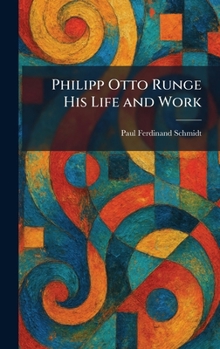
Philipp Otto Runge His Life and Work

"Philipp Otto Runge His Life and Work" offers a comprehensive exploration of one of the most significant figures in German Romanticism. Written by art historian Paul Ferdinand Schmidt, this study delves into the profound creative output and philosophical foundations of Philipp Otto Runge, a painter and draughtsman whose influence far exceeded his short life. The work examines Runge's unique approach to color theory, his intricate allegorical compositions, and his role in redefining the spiritual dimensions of art during the early nineteenth century.
The text provides critical insight into the artist's major works, including his visionary cycle "The Times of Day," and contextualizes his contributions within the broader Romantic movement. Schmidt highlights Runge's connections to other intellectual giants of the era, such as Caspar David Friedrich and Johann Wolfgang von Goethe, illustrating how his innovative ideas bridged the gap between painting, mysticism, and science. This volume serves as an essential resource for those interested in the evolution of European art history and the enduring legacy of a visionary who sought to capture the divine in the natural world.
This work has been selected by scholars as being culturally important, and is part of the knowledge base of civilization as we know it. This work was reproduced from the original artifact, and remains as true to the original work as possible. Therefore, you may see the original copyright references, library stamps (as most of these works have been housed in our most important libraries around the world), and other notations in the work.
This work is in the public domain in the United States of America, and possibly other nations. Within the United States, you may freely copy and distribute this work, as no entity (individual or corporate) has a copyright on the body of the work.
As a reproduction of a historical artifact, this work may contain missing or blurred pages, poor pictures, errant marks, etc. Scholars believe, and we concur, that this work is important enough to be preserved, reproduced, and made generally available to the public. We appreciate your support of the preservation process, and thank you for being an important part of keeping this knowledge alive and relevant.
Customer Reviews
ThriftBooks® and the ThriftBooks® logo are registered trademarks of Thrift Books Global, LLC
