


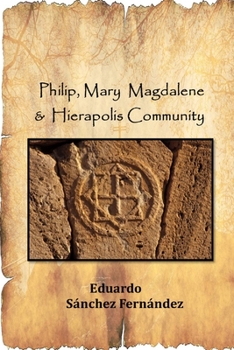
Philip, Mary Magdalene & Hierapolis Community
No Customer Reviews

The following work has been the result of painstaking research through the New Testament scriptures and preserved patristic sources; relying on both historians, philologists and biblical scholars. From the Acts of the Apostles, through the small fragments that came to us from Papias of Hierapolis in Phrygia of Asia Minor and Hegesippi in Jerusalem, whose works would be of great value for the study of early Christianity and suffered from the underestimation by the orthodoxy carried out by the Great Church. The proposal to identify the beloved disciple with Philip for those who lived with him in the community of Hierapolis is novel, but what is substantial is to delve into the historical substratum present in the Acts of Philip beyond what is considered to be a legendary whole. This does not include episodes XIII to XV, which reflect the arrival of Philip, Mary Magdalene and finally Nathanael, son of Ptolemy (Bartholomew)*, although it could well have been Andrew in their place. It was by chance that in 2007 I began to give shape to this hypothesis, which arose when I observed the disparity between the cast of apostles in the Synoptic Gospels (Mark, Matthew and Luke) and the Fourth Gospel traditionally attributed to John the son of Zebedee. The community of the IV Gospel highlighted and made known the apostles only mentioned in the Synoptic Gospels and with no other role in the ministry of Jesus. If it had not been for this Gospel we would not have known more about Philip, Judas Thomas, Nathanael son of Ptolemy (Bartholomew) and Judas Thaddeus-Lebaeus. Because from Andrew, Simon Peter's brother "Cephas" something had been advanced in the Synoptics. The testimony of this community was very courageous and entered into competition with the Pauline wing (Mark and Luke). Thanks to this we can reconstruct that the first person to whom Jesus appeared was Mary Magdalene and she was not accompanied by other women. It was she alone who, as we shall see, brought about this phenomenon that has given hope to more than two billion people in a heavenly life after death on earth. First of all, I have tried to offer a perspective that will look at the historical as opposed to the theological interests of each evangelist and his community.Let us look at the gospel with a critical eye and you will discover how the true Jewish background was made up for better adapting and selling itself to the Gentile world. You will find non-Jewish, rather Gentile and pagan behavior when women go to the tomb to anoint the body of Jesus after the tomb is closed with the rolled stone. The Jewish mentality used to wait 12 months and not go to the third day, it was supposed that he would rise in soul after that time and then they would go to gather his bones in an ossuary. Another pagan gesture is at the last supper when Jesus puts something in his mouth that he did not say, referring to the fact that the bread shared is his body and the wine is his blood. It is incongruous for an observant Jew of those days to think that eating blood is even against Noah's laws. The historical Jesus and his quest is Jewish essence rather than blind interests in a volley of dogmatic symbolism that is unfounded.The Community of the Fourth Gospel was divided by the glorious birth of Jesus, of a divine inseminated nature and produced in Bethlehem by Matthew and Luke. Instead they defended their humble origin from the village of Nazareth Jn 1:46. His father is not Zeus, it was Joseph of Nazareth.In spite of the high load of theological material and the Jesus so blurred with respect to the Synoptics, omniscient and who seems not to complain bitterly about being abandoned by Yahweh, as described in Mark.In part the historical memory of the beloved disciple was altered by the emergence of the Paraclete and in part by the adaptation to the theological framework of the emerging Great Church, which I will call the Traditional Apostolic Church.
Format:Paperback
Language:English
ISBN:B08HT866BM
ISBN13:9798685612113
Release Date:October 2019
Publisher:Independently Published
Length:112 Pages
Weight:0.35 lbs.
Dimensions:0.2" x 6.0" x 9.0"
Customer Reviews
0 rating
Copyright © 2026 Thriftbooks.com Terms of Use
| Privacy Policy | Do Not
Sell/Share My Personal Information | Cookie Policy | Cookie Preferences | Accessibility Statement
ThriftBooks® and the ThriftBooks® logo are registered trademarks of Thrift Books Global, LLC
ThriftBooks® and the ThriftBooks® logo are registered trademarks of Thrift Books Global, LLC
