


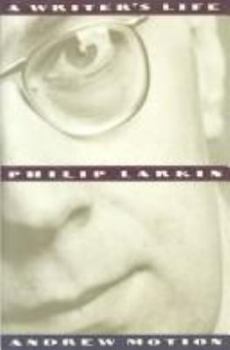
Philip Larkin: A Writer's Life

Select Format
Select Condition 
Book Overview
American
Format:Hardcover
Language:English
ISBN:0374231680
ISBN13:9780374231682
Release Date:January 1
Publisher:Farrar, Straus & Giroux
Length:570 Pages
Weight:2.23 lbs.
Dimensions:1.7" x 6.4" x 9.5"
Customer Reviews
4 ratings
A life renounced
Published by Thriftbooks.com User , 16 years ago
Andrew Motion does justice to the remarkable life of Philip Larkin in this moving biography. Since his death 25 years ago, Larkin has been bestowed with mythic status as the 'hermit of Hull'. A recluse who hid himself from the world to concentrate on his poetry, which line by line arrows home like no other at the bleak, circumscribed conditions of average human lives. This biography reveals the emotional tumult beneath the surface of Larkin's 'ordinary' life. Renouncing the domestic comforts of a wife and children (his attitude to this revealed in his poetry such as Dockery and Son), Larkin lived most of his life behind the 'High Windows' of Pearson Park in Hull, working at an unassuming (though not ineffective) administrative job in Hull University Library. Much of his life was spent fearful of death - a 'Black sailed unfamiliar', and the final chapters, measured out by number virtually correlating to the years of Larkin's life, read almost like a thriller as Larkin physically weakened by cancer approaches death probably as the person who has most prepared himself in a lifelong sacrifice for the end of life. Larkin's love life was most complex. Rather than sex beginning in 1963, as he implies in 'Annus Mirabilis', Larkin conducted a delicate weave of relationships with feisty lecturer Monica Jones, and his co-worker Maeve Brennan, never fully committing to any of his lovers lest they intrude on the bleak solitude Larkin believed necessary for his poetry. And so it proved. Larkin's final years were even more miserable than the rest of his life as he became plagued by alcoholism and self regret. His was truly a 'writer's life', as the title denotes, sacrificing the standard pleasures of family companionship for his work - which bleakly and precisely, traditional form and modern in theme, delineates the universal sorrows and anxieties of life passing, and hopes slipping away. No other modern British poet has had the courage or talent to stare down the barrels of life so squarely, without shirking from the truths he sees there. Truly our greatest postwar poet.
Champagne, Not Sparkling Wine
Published by Thriftbooks.com User , 19 years ago
This magnificent biography reads like a novel. The prose is smooth and clear; this is decidedly not an academic biography. It belongs firmly to the art of literary biography for which the British are renowned. Larkin comes over as a classic eccentric on the order of his friends and contemporaries such as Kingsley Amis. The biography shows again how strong the reaction to social fascism can be; Larkin, like Waugh, Graham Greene and Muggeridge, had a visceral, instinctive mistrust of the Welfare State and its ideology of social "progress." His struggles with women are instructive, but only go to show once again that when asked to choose, some people prefer art to nappies and love. Motion, Martin Amis has pointed out, has a tendency to judge Larkin according to PC standards, thus finding him on the wrong side of history's recent celebration of all things human. Amis, not Motion, makes the case that Larkin should be judged by the standards of this time; if he was a racist, his was an ordinary bigotry, not the over-wrought, systematic racism of the Nazis. No doubt he was impossible to know or be around, but Motion's affectionate, if critical, treatment would be well-advised to consider Amis' warning to keep our faith in the triumph of the individual against the modern mob's claim to all-knowingness.
Philip Larkin
Published by Thriftbooks.com User , 20 years ago
Andrew Motion is a poet and novelist whose earliest poems were lyrical and highly influenced by the work of Philip Larkin. He writes of Larkin in this biography with respect and candor, and not as a hero-worshiper (or disparager). Larkin's life, because of his reclusive nature, was not an open book, and he had a dark side, which contrasts greatly with the kind of lyrical, often witty (though at times bitter) poetry he produced. Larkin wrote poetry from an early age, though his first desire was to be a novelist. In fact he wrote two novels, neither of which made much of a hit, and he could write no others. He worked every day as a librarian at Brynmor Jones Library in Hull. He loved traditional jazz and wrote frequently about it. He never married, but had two mistresses; one he mistreated badly. He could be funny and also mean-spirited. There were many parts to the man, some at odds with others. Motion does a good job fleshing these sides out and dealing with them without passing judgment. It's a fair and balanced, well-written biography. Recommended.
Humbug
Published by Thriftbooks.com User , 22 years ago
Ignore the previous writer. This is one of the handful of truly fine literary biographies from the last fifty years, maybe more. Unless Larkin himself was fully devoted to falsifying the record, he was every bit the unrelenting prig Motion has made him out to be; and not only does Motion show how Larkin as an artist transcended this, Motion personally knew and liked Larkin. Nowhere does Motion naively simplify the cause and effect between Larkin's childhood and his adult unhappiness --again, the facts are laid out judiciously, and the reader is free to draw conclusions. Finally, the idea that Motion, a Poet laureate, acquaintance of Larkin, and a gifted literary essayist, is somehow lacking in his analysis of the poems is nonsense. Motion takes us through the major work without allowing it to dominate the narrative which is, after all, about Larkin's life. All in all, this is a remarkable piece of literary journalism; absolutely first rank. That anyone interested in Larkin would be scared off by the prior casual dismissal, inattentive as it is, is a travesty.
Copyright © 2026 Thriftbooks.com
Terms of Use | Privacy Policy | Do Not Sell/Share My Personal Information | Cookie Policy | Cookie Preferences | Accessibility Statement
ThriftBooks ® and the ThriftBooks ® logo are registered trademarks of Thrift Books Global, LLC
ThriftBooks ® and the ThriftBooks ® logo are registered trademarks of Thrift Books Global, LLC
