


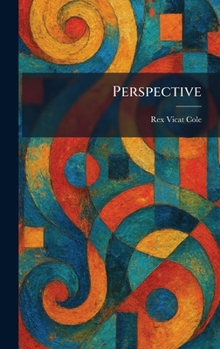
Perspective

"Perspective" by Rex Vicat Cole remains one of the most comprehensive and accessible guides to the mastery of depth and space in the visual arts. Written by an accomplished landscape painter and instructor, this work bridges the gap between complex mathematical theory and the practical needs of the artist. The text provides a thorough exploration of linear perspective, covering everything from basic principles to the intricate depiction of shadows, reflections, and architectural details.
Throughout "Perspective", Cole emphasizes the importance of observation, teaching the reader how to translate three-dimensional reality onto a two-dimensional surface with precision and flair. The work is particularly noted for its clear, step-by-step approach, making it an essential resource for students of drawing and painting. By examining the way objects appear to change shape and size in relation to the viewer's position, Cole equips artists with the tools necessary to create convincing and immersive compositions.
Whether dealing with the vast horizons of a landscape or the structured lines of an interior, "Perspective" offers timeless insights into the mechanics of vision. This foundational text continues to be a valuable reference for anyone seeking to improve their technical proficiency and artistic expression in the classical tradition.
This work has been selected by scholars as being culturally important, and is part of the knowledge base of civilization as we know it. This work was reproduced from the original artifact, and remains as true to the original work as possible. Therefore, you may see the original copyright references, library stamps (as most of these works have been housed in our most important libraries around the world), and other notations in the work.
This work is in the public domain in the United States of America, and possibly other nations. Within the United States, you may freely copy and distribute this work, as no entity (individual or corporate) has a copyright on the body of the work.
As a reproduction of a historical artifact, this work may contain missing or blurred pages, poor pictures, errant marks, etc. Scholars believe, and we concur, that this work is important enough to be preserved, reproduced, and made generally available to the public. We appreciate your support of the preservation process, and thank you for being an important part of keeping this knowledge alive and relevant.
Customer Reviews
ThriftBooks ® and the ThriftBooks ® logo are registered trademarks of Thrift Books Global, LLC
