


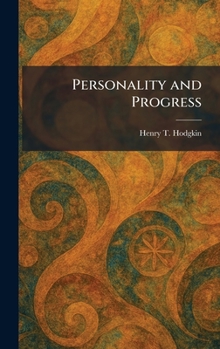
Personality and Progress

"Personality and Progress" by Henry T. Hodgkin explores the profound relationship between individual character and the broader evolution of human society. Writing from a perspective deeply influenced by Quaker values and international experience, Hodgkin argues that true social progress is inextricably linked to the spiritual and intellectual development of the individual personality. The work examines how personal integrity, empathy, and moral growth serve as the foundational building blocks for a more just and harmonious world.
In this thought-provoking study, Hodgkin challenges readers to consider the responsibilities of the individual in an increasingly complex and interconnected age. He delves into themes of creative living, the role of education in shaping character, and the necessity of aligning one's inner life with outward actions for the betterment of the community. "Personality and Progress" remains a significant contribution to early 20th-century social and religious thought, offering timeless insights into how the cultivation of the self can lead to the transformation of society. This book is an essential read for those interested in the history of social reform, Christian ethics, and the philosophical underpinnings of personal development.
This work has been selected by scholars as being culturally important, and is part of the knowledge base of civilization as we know it. This work was reproduced from the original artifact, and remains as true to the original work as possible. Therefore, you may see the original copyright references, library stamps (as most of these works have been housed in our most important libraries around the world), and other notations in the work.
This work is in the public domain in the United States of America, and possibly other nations. Within the United States, you may freely copy and distribute this work, as no entity (individual or corporate) has a copyright on the body of the work.
As a reproduction of a historical artifact, this work may contain missing or blurred pages, poor pictures, errant marks, etc. Scholars believe, and we concur, that this work is important enough to be preserved, reproduced, and made generally available to the public. We appreciate your support of the preservation process, and thank you for being an important part of keeping this knowledge alive and relevant.
Customer Reviews
ThriftBooks ® and the ThriftBooks ® logo are registered trademarks of Thrift Books Global, LLC
