


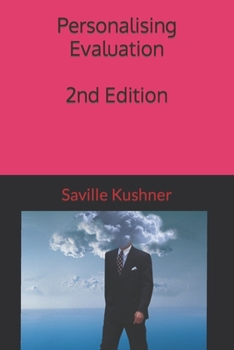
Personalising Evaluation

This second edition and republication of Personalizing Evaluation challenges the mainstream approach to program evaluation by inverting the traditional relationship between program and person. It is written especially for research students and their supervisors, but also for practising researchers and evaluators. This is primarily a methodological text, focused on democratic and humanist principles and exploring the use of data drawn from evaluation projects. It explores a deceptively simple proposition: that we should invert the relationship between program and person. That rather than see how people fit into the life of a program, evaluative researchers should show how programs fit (or don't) into people's lives. The book serves well as a supervision resource since it contains and exemplifies substantial amounts of data taken from evaluation reports (in the performing arts). It brings to the forefront, therefore, the challenge of interpreting, analysing and presenting narrative data. The book covers the personal experience both of being a researcher and of being researched. One of the threads that runs throughout the book concerns the ethical and moral obligations of the researcher and evaluator. He uses a wealth of examples and case studies to illustrate how a deeper understanding of program evaluation can be achieved across a range of issues and applications.
Saville addresses three principal concerns that are at the heart of the evaluation process: how to learn about evaluation in ways which are related to the often confusing and messy experience of doing it; how to understand the role of evaluation as a form of personal expression and, even, political action; and how to use evaluation to say something about people's lives as well as about the programs and institutions people are involved in.
A brilliant piece of work, adroitly fitted to the present state of affairs in program evaluation, devoted to a defensible and under-attended proposition - that we should understand programs through their recipients' -Robert Stake, University of Illinois
Customer Reviews
ThriftBooks® and the ThriftBooks® logo are registered trademarks of Thrift Books Global, LLC
