


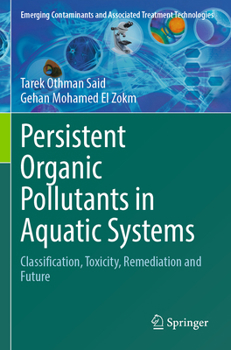
Persistent Organic Pollutants in Aquatic Systems: Classification, Toxicity, Remediation and Future

This book addressed an in-depth comprehension of the classifications and characterizations of POPs, which have become global issues due to bioaccumulation, persistency, and toxicity. It represents the milestones of the development of pesticide application, industry, and management. Banned SC-POPs have special investigations. It discusses air-sea exchange, ocean currents, phase distribution, speciation, adsorption, desorption, and degradation as the key processes that control POP's fate. The book explores several aspects of POP chemistry that have a direct influence on their biochemical and toxicological consequences. The book illustrates the dynamic equilibriums influencing the proportion of a POP's gaseous, liquid, and solid phases. The book discussed POP migration by referring to the grasshopper effect. It also explores the impacts of climate change on emissions and the fate of POPs through a global-scale multimedia fate model. Additionally, it displays the impact of potential global change scenarios on POP bioaccumulation patterns. The book is directed at giving a deep discussion of the method's QA/QC process for POP determination and has verified the accuracy and precision of the procedures. As a distinctive point, it discusses many aspects concerning the toxicity of POPs. It reports mechanisms describing the toxicity of POPs on immune systems, carcinogenesis, endocrine, neural, and reproductive systems. The book keeps an eye on a model describing the global distribution and toxicity of PAHs. Among the exclusive points in the book is the evaluation of the recent ecological status in Egypt relative to POPs through a time-scale overview and recent case studies. It provides thematic literature related to DDC research in Africa through the WoS and Scopus databases from 1949 to 2021. The book emphasizes models for predicting the annual contribution rate of POPs as a way to raise public awareness about POPs. The greatest challenge for the book is how to motivate the audience to be aware of these hazardous materials in marine ecosystems. Moreover, this book will be of great interest to academics, professionals, practitioners, post-graduate students, and undergraduates because it gives a clear overview of POPs in the marine environment. It also provides decision-makers with a realistic perspective of the environmental file, allowing them to address environmental issues and directing stockholders to safer locations for environmental activity. From a future perspective, the regulation of pervasive POPs, with special reference to recently evaluated harmful substances (PFASs), has faced significant challenges in the wake of pressure from regulators.
Related Subjects
Engineering Science Science & Math Science & Scientists Science & Technology TechnologyCustomer Reviews
ThriftBooks® and the ThriftBooks® logo are registered trademarks of Thrift Books Global, LLC
