


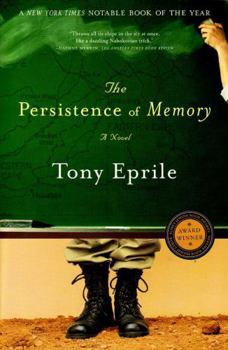
Persistence of Memory (Revised)

Select Format
Select Condition 
Book Overview
In this humane yet savagely witty portrait of apartheid South Africa in its waning years, Tony Eprile renders his homeland's turbulent past with striking clarity. The Baltimore Sun declared Eprile's "horrifying yet heartrendingly beautiful" prose to be "comparable to his fellow authors of Apartheid Andre Brink and Nadine Gordimer." As the novel builds to a harrowing conclusion, the protagonist, a veteran of the secret war in Angola and Namibia, is forced to appear before the Truth and Reconciliation Committee with astonishing results. Nobel Prize-winning author J. M. Coetzee calls The Persistence of Memory "a story of coming to maturity in South Africa in the bad old days. Always warm-hearted, sometimes comic, ultimately damning." Reading group guide included.
Format:Paperback
Language:English
ISBN:0393327221
ISBN13:9780393327229
Release Date:July 2005
Publisher:W. W. Norton & Company
Length:304 Pages
Weight:0.70 lbs.
Dimensions:0.8" x 5.6" x 8.3"
Related Subjects
Contemporary Ethnic & National Fiction Genre Fiction Historical Jewish Literary Literature & FictionCustomer Reviews
4 ratings
Memory and atrocity and the narrative of history
Published by Thriftbooks.com User , 20 years ago
One of the lessons to be learned from The Persistence of Memory is that a photographic memory does not necessarily tell the larger truth. The short and perfectly recollected moments in the life of Paul Sweetbread (the protagonist with perfect recall) add up to a whole that is somehow less than the sum of its parts. Sweetbread is unconvincing and unreliable as a narrator precisely because his grip on the details is so startlingly clear. Cameras lie, Eprile tells us. The propaganda corps of the South African army stage scenes where soldiers play football with local children. Judicious cropping is all that is needed to make the perfect observer into one that cannot be trusted. The comparison with Sweetbread as witness is inevitable. I can think of very few metaphors that would work better for the process of truth and reconciliation in South Africa. It is a brilliant idea for a book, and one that seems to fit perfectly with the situation that it is describing. The flaw in the book is that it seems to try to do too much above and beyond developing this central idea. The Persistence of Memory is also a coming of age story, and also has a lot to do with the response of Paul as a human (and not a camera) to what he sees in Namibia. There is a lot of material, and unfortunately the beautifully written individual scenes do not seem to gel very effectively into a larger whole. As a reading experience, I found it disjointed and ultimately unsympathetic. It might sound strange to sum up a review by saying that while I admire the book immensely, I am not certain how widely I would recommend it. I certainly think that it would be of interest to people who have read a lot in the literature of South Africa. I can also tell you that it makes a satisfactory book for a book club. We had a lot to talk about after it was finished. It is at least an impressive effort. Eprile is a writer to watch for the future. Read it for yourself to decide what you think.
"What will become of us all?"
Published by Thriftbooks.com User , 21 years ago
South Africa from 1968 - 2000 is revealed in all its cultural variety and internal stresses through the life story of Paul Sweetbread, an overweight Jewish boy who is an outsider to everyone. Neither a Boer nor an Englishman, he is also not really a Jew, since his family has never been observant, leaving him without any common roots that connect him to his Caucasian countrymen. A person with a photographic memory, he is, from the outset, a victim of his memory. Because he can quote from his schoolbooks exactly, teachers think he cheats; his fellow students torment him. As he sets the scene and creates a fully drawn personality for Paul, the author recreates his early school and home life, his relationships with black servants, and his family history, including the death of his father. The action intensifies when Paul, having finished school in 1987, joins the South African Defense Force for two years, instead of going to college. South Africa is nervously protecting its borders against what it believes are communist insurgents, while also facing threats from within. Apartheid has been challenged, the British and Boers are at odds, and African nationalism is growing. Paul's wartime experiences, recreated in stunning detail, further develop his character as he observes Captain Lyddie, "The perfect specimen of South African manhood," engaging in racial brutality, described in passages of great power which embed themselves in Paul's perfect memory and in the reader's. The battle for survival of South Africa and the changes which will be necessary as the country changes from white to black rule are ever at the forefront of the novel. Paul's empathy for the Bushmen, whom the SADF uses as trackers, is palpable, while his fear, engendered during a photo assignment in a black township, reflects his awareness of the dangers from within. Thoughtful and challenging but filled with wry humor, Eprile's novel presents events from Paul Sweetbread's life slowly, sometimes deliberately omitting important information in order to maintain suspense and let the reader come to know Paul through his life and actions, rather than through background information. He creates a sympathetic picture of an extremely sensitive young man who finds himself in impossible situations which mark him for life. His philosophical musings near the end of the book about memory and metaphor raise important questions about society and national "memory," how a country constructs its memories of the past in order to make it acceptable, and careful readers will savor the language and sheer intelligence of Eprile's observations. Mary Whipple
A Cautionary and Prophetic Novel for South Africa
Published by Thriftbooks.com User , 21 years ago
Why is Tony Eprile's powerful and highly literary novel about his growing up in apartheid South Africa nowhere to be found in the popular chain bookstores in the prosperous shopping malls in Johannesburg and Cape Town? Probably for the same reason that most white South Africans, save the unrehabilitated right-wing Africaners, deny having anything to do with the horrors of Apartheid. Raising the unpleasantness of the inhumanities of this state-sponsored policy at a dinner party in South Africa is considered poor taste, much as discussion of the camps was eschewed by polite German society of the 1950's and 1960's. The past is just that, so reason so many white South Africans, who drive their Mercedes and BMW's past vast squatter shanty towns bordering the verdant suburbs, where affluent, largely white communities appear to thrive amid the sea of need that contains so many of the country's black citizens. In one such Cape Town suburb an office of Sotheby's International Real Estate is located directly across the road from a particularly miserable shanty town. "Memory is itself a subversive act," writes Eprile, and the absence of memory destines so many whites in South Africa to luxurate in total denial of the active volcano they live atop. The future of South Africa is a matter of great importance, if only for the great human suffering which would occur if the country were to implode as Zimbabwe has. Tony Eprile's novel would merit serious attention for its articulate, literary style alone. But as a cautionary and prophetic view of South Africa's past and future, it is a mirror for anyone who cares about injustice and its peaceful resolution, both in Africa and in western countries which are still struggling with racism and the inhumanities thereof.
Wow.
Published by Thriftbooks.com User , 21 years ago
Tony Eprile has constructed an impressive novel of a changing South Africa that is both warm and bitingly funny, even as it exposes a heart - and a country - torn to shreds. Narrator Paul is a Jew, neither Afrikaner nor Englishman, whose love for food and unblinking memory makes him the butt of schoolyard jokes from students and teachers alike. When he is later sent into Namibia to a war his homeland doesn't officially recognize, he finds that he is as much a misfit there as he was in school, although here the stakes are much higher. What Paul sees, for he can never forget the smallest details of anything, stays within him, tormenting him, crippling him, but never destroying his lugubrious sense of humor.What marks this novel as an exceptional literary work is not its plot, or even its lovable protagonist, but the detail and wit the author uses to dismantle the many facets of a complicated country. Through Paul's story, Eprile shows the changing political climate, the ethnic divisions (not only between blacks and whites), the suburbs and cities, the schools, the national consciousness, and the tensions that continue to exist despite an eventual end to apartheid. Although Eprile occasionally gets carried away with his often complicated prose, it's usually for comic effect, as in this description of a fly: "It sits in my palm, this winged myrmidon that was around to torment the first land mammals scurrying to avoid the attention of the giant saurians, rubbing its hands together like a surgeon scrubbing up." This novel, a debut after a collection of stories, is a compelling, sharp portrait of a nation as seen through the eyes of a misfit. Eprile manages to pull off his prose pyrotechnics without sacrificing an honest, emotional engagement with his subject matter. I cannot find enough superlatives to describe this wonderful novel, one of the best I've read this year.
Copyright © 2026 Thriftbooks.com Terms of Use
| Privacy Policy | Do Not
Sell/Share My Personal Information | Cookie Policy | Cookie Preferences | Accessibility Statement
ThriftBooks® and the ThriftBooks® logo are registered trademarks of Thrift Books Global, LLC
ThriftBooks® and the ThriftBooks® logo are registered trademarks of Thrift Books Global, LLC
