


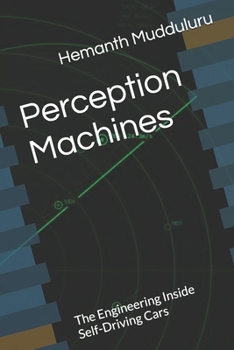
Perception Machines: The Engineering Inside Self-Driving Cars
No Customer Reviews

How do self-driving cars actually see the world?
Perception Machines is a technical field guide to the algorithms, sensors, and compute architectures behind modern driver-assistance and autonomous-driving systems. It connects theory to the real systems decisions engineers make every
day - from sensor selection to latency budgets.
Inside you'll learn:
How cameras, radar, lidar, and ultrasonics each perceive the driving scene - and where each one failsSensor fusion: how modern stacks combine modalities into one coherent world modelThe compute architecture behind real-time perception, from SoCs to acceleratorsLatency budgets and systems trade-offs that shape every ADAS programHow perception requirements flow down into validation, safety, and homologationWho this book is for:
ADAS and autonomous-vehicle engineers who want the full systems pictureRobotics engineers moving into automotive perceptionEngineering graduate students studying sensor fusion and real-time systemsTechnical product managers and leaders who need to speak the language of perceptionWritten by an ADAS engineer with industry experience at automotive suppliers, a patent in the field, and published IEEE research, this book skips the hype and focuses on what actually ships in vehicles.
If you build, study, or lead teams working on machines that perceive the world - this is your field manual.
Format:Paperback
Language:English
ISBN:B0GTHPV7L9
ISBN13:9798253163979
Release Date:March 2026
Publisher:Independently published
Length:159 Pages
Weight:0.50 lbs.
Dimensions:9.0" x 0.4" x 6.0"
Customer Reviews
0 rating
Copyright © 2026 Thriftbooks.com
Terms of Use | Privacy Policy | Do Not Sell/Share My Personal Information | Cookie Notice | Cookie Preferences | Accessibility Statement
ThriftBooks ® and the ThriftBooks ® logo are registered trademarks of Thrift Books Global, LLC
ThriftBooks ® and the ThriftBooks ® logo are registered trademarks of Thrift Books Global, LLC
