


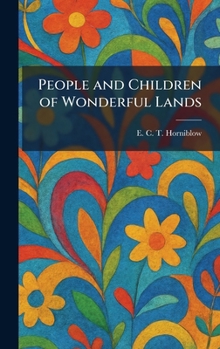
People and Children of Wonderful Lands

"People and Children of Wonderful Lands" is a captivating educational survey designed to introduce readers to the diverse cultures and lifestyles found across the globe. Written during the early 20th century, this work offers an insightful glimpse into how different societies and their traditions were presented to students of the era. E. C. T. Horniblow guides the reader through various continents, focusing specifically on the daily lives, dress, and environments of families and children in distant regions.
Through its descriptive narrative, the book explores the unique customs of various "wonderful lands," highlighting the geographical features and social structures that define them. From remote villages to bustling international centers, the text emphasizes the diversity of human experience. Horniblow presents a world of discovery, making complex geographical and anthropological themes accessible and engaging. This work serves as an important resource for understanding historical educational approaches to world geography and social studies, preserving a specific period's perspective on global diversity and international heritage.
This work has been selected by scholars as being culturally important, and is part of the knowledge base of civilization as we know it. This work was reproduced from the original artifact, and remains as true to the original work as possible. Therefore, you may see the original copyright references, library stamps (as most of these works have been housed in our most important libraries around the world), and other notations in the work.
This work is in the public domain in the United States of America, and possibly other nations. Within the United States, you may freely copy and distribute this work, as no entity (individual or corporate) has a copyright on the body of the work.
As a reproduction of a historical artifact, this work may contain missing or blurred pages, poor pictures, errant marks, etc. Scholars believe, and we concur, that this work is important enough to be preserved, reproduced, and made generally available to the public. We appreciate your support of the preservation process, and thank you for being an important part of keeping this knowledge alive and relevant.
Customer Reviews
ThriftBooks ® and the ThriftBooks ® logo are registered trademarks of Thrift Books Global, LLC
