


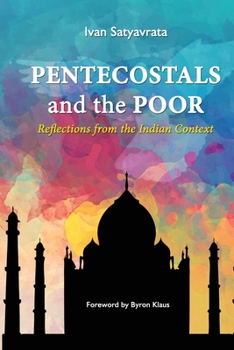
Pentecostals and the Poor: Reflections from the Indian Context [Large Print]

Th e immediate occasion for my refl ection on this theme was
an invitation from the Asia Pacifi c Th eological Association APTA]
to address their General Assembly at Chiang Mai, Th ailand, in the
Fall of 2011. I was asked to present four lectures, reflecting on
the topic of Power, Tradition & Social Engagement, with a focus
on how these themes may be integrated in theological education
and the equipping of leaders for ministry in Asia.
Although the theme was not my selection, it was not long
before I found myself deeply absorbed in it for several reasons. To
begin with, my personal spiritual journey had involved exposure
to several older Christian traditions. My paternal grandfather was
a Presbyterian minister in the German Basel Mission, which had a
strong presence along the south west coast of India during the
earlier years of Protestant missions in India. My parents, however,
attended a Methodist Church during my growing years in the city
of Bombay (now Mumbai) and later became members of an Evangelical
Alliance Church. My schooling was in a Church of England
school, but it was the Charismatic movement in Bombay that shaped
my discipleship following my conversion at the age of seventeen.
Later, I found my church home in the Assemblies of God.
My subsequent theological journey exposed me to infl uences
from a wide variety of traditions, including Pentecostal, Brethren, Baptist, Reformed Anglican and Roman Catholic. Whenever I
heard references being made to the "Reformed" tradition or
"Anglican" tradition or "Roman Catholic" tradition, I would oft en
wonder whether it would be appropriate to speak of a "Pentecostal"
tradition and, if so, how should it be described? My research
led me to conclude that not only was it appropriate to refer to a
Pentecostal tradition, but that despite some challenges of characterization
posed by the diverse nature of the Pentecostal movement,
the "traditioning" process was in fact an urgent necessity. Failure
to do so in a timely manner could result in the emergence of inauthentic
and inadequate depictions of the Pentecostal tradition that
fail to fairly represent its roots and distinctives. Th ese papers are a
small contribution towards a broader ongoing global task that I
trust more Pentecostal scholars will pay attention to in future.
A second reason this theme gripped my interest was because it
brought together two of my deepest passions in ministry. My earliest
years in ministry were spent as a grass-roots evangelist in the
streets and slums of Bombay. I was engaged subsequently in
church-planting eff orts, fi rst in downtown Bombay and then in a
city in North India. When I joined the faculty at Southern Asia
Bible College (now Centre for Global Leadership Development),
Bangalore, it was because of the promise it held for raising leaders
who would powerfully impact Christ's Church-in-mission all
across South Asia. Aft er twenty-one years in institutional leadership
training, we were called to a very unique pastoral ministry in
Kolkata-a local church which served as the hub of a Mission with a
strong social outreach across East India.
One of two questions that frequently had me preoccupied and
with which I oft en struggled in the course of my mission engagement
was: How should the relationship between evangelism and social
Related Subjects
Bible Bibles Biblical Christian Christian Books & Bibles Christianity Religion Religion & SpiritualityCustomer Reviews
ThriftBooks ® and the ThriftBooks ® logo are registered trademarks of Thrift Books Global, LLC
