


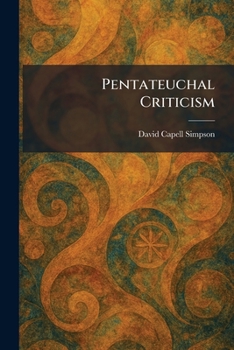
Pentateuchal Criticism

"Pentateuchal Criticism" provides a detailed and scholarly introduction to the historical-critical analysis of the first five books of the Bible. Authored by David Capell Simpson, this work examines the literary foundations and compositional history of the Torah, navigating the complex theories that define modern Old Testament scholarship. The text addresses the documentary hypothesis and the various linguistic and historical layers that constitute the Mosaic books, offering a clear synthesis of the debates surrounding their origins.
Designed for students, theologians, and historical researchers, this work clarifies the methodology used to distinguish the diverse traditions found within the biblical narrative. Simpson balances academic rigor with accessibility, making the intricacies of higher criticism understandable to a broader audience. By focusing on the structural and thematic developments of these foundational scriptures, "Pentateuchal Criticism" remains a valuable resource for anyone seeking to understand the evolution of biblical interpretation and the historical context of the Old Testament. Its objective approach highlights the literary significance and enduring impact of these sacred texts on Western religious thought.
This work has been selected by scholars as being culturally important, and is part of the knowledge base of civilization as we know it. This work was reproduced from the original artifact, and remains as true to the original work as possible. Therefore, you may see the original copyright references, library stamps (as most of these works have been housed in our most important libraries around the world), and other notations in the work.
This work is in the public domain in the United States of America, and possibly other nations. Within the United States, you may freely copy and distribute this work, as no entity (individual or corporate) has a copyright on the body of the work.
As a reproduction of a historical artifact, this work may contain missing or blurred pages, poor pictures, errant marks, etc. Scholars believe, and we concur, that this work is important enough to be preserved, reproduced, and made generally available to the public. We appreciate your support of the preservation process, and thank you for being an important part of keeping this knowledge alive and relevant.
Customer Reviews
ThriftBooks® and the ThriftBooks® logo are registered trademarks of Thrift Books Global, LLC
