


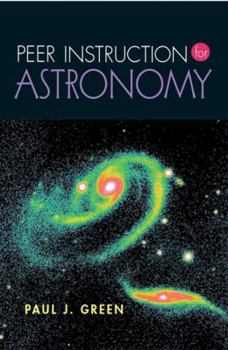
Peer Instruction for Astronomy


Select Format
Select Condition 
Book Overview
"Peer Instruction for Astronomy" is an instructor's guide to an exciting and easily-implemented enhancement for lecture classes in introductory astronomy. Application of this powerful and efficient... This description may be from another edition of this product.
Format:Paperback
Language:English
ISBN:0130263109
ISBN13:9780130263100
Release Date:August 2002
Publisher:Addison-Wesley
Length:178 Pages
Weight:0.60 lbs.
Dimensions:9.0" x 0.5" x 6.0"
Customer Reviews
2 ratings
THE perfect companion to any astronomy textbook
Published by Thriftbooks.com User , 19 years ago
If you buy only one teaching book, this should be the one. Whether you are teaching at the high school or college level, Peer Instruction for Astronomy will enliven your class and help your students learn. Paul Green has made it very easy for astronomy instructors to improve interactive learning in lectures with little upfront work. The introductory chapters of the text are informative and persuasive. Most importantly they represent conventional wisdom from the physics and astronomy educational research communities in a language accessible to all. Paul has done the hard work of cobbling together an extensive collection of well-written concept-tests that will spark engagement and understanding in even the most reluctant learner. Use this book and method, and everyone involved in your course will be happier and better educated in the end. It's that simple.
Collection of Astronomy Concept Tests
Published by Thriftbooks.com User , 20 years ago
A semi-sequel to Mazur's Peer Instruction: A User's Manual, Green follows Mazur's lead in exhorting intro Astronomy teachers, rather than intro Physics teachers to adopt peer instruction through concept tests as a means of actively engaging students in what has traditionally been a large lecture format class. As Mazur does in his text, Green spends the first 30 pages making the case for cooperative learning in general and peer instruction via concept tests in particular, as well as describing how concept tests can be implimented in the typical large lecture-hall, undergrad intro-astro classroom. Concept tests are multiple choice questions intended to be given shortly after a topic has been covered in a traditional lecture. Small groups of students (usually pairs) try to persuade each other of the correctness of their answer before their final answer is submitted to the instructor. The bulk of the book is found in the fifth chapter which consists of over 400 concept test questions. The cover such topics as: The Night Sky, The Celestial Sphere Seasons, Time, Eclipses Measures & Units, Distance, Magnitude Astronomical Methods, Telescopes History Orbital Motion, Forces and Acceleration scale elements Radiation and the EM spectrum The Earth, Moon, Planets, Asteroids, Comets The Sun, Stelar Properties, Star Formation, Stellar Evolution Binary Stars, Stellar Populations Galaxies, Quasars Cosmology, Dark Matter, the Origin & Evolution of Life Also included is a diagnostic test of initial astronomical knowledge akin to the FCI. Both this and the questions are included on a CD in both MSword & pdf format. The questions in general are appropriate both for college and the high school level, though you'll likely have to alter and drop some to adapt it to your own course.
Copyright © 2026 Thriftbooks.com Terms of Use
| Privacy Policy | Do Not
Sell/Share My Personal Information | Cookie Policy | Cookie Preferences | Accessibility Statement
ThriftBooks® and the ThriftBooks® logo are registered trademarks of Thrift Books Global, LLC
ThriftBooks® and the ThriftBooks® logo are registered trademarks of Thrift Books Global, LLC
