


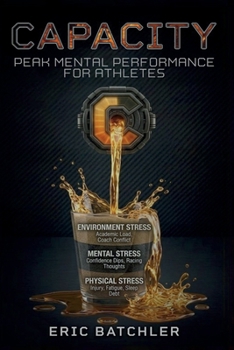
Peak Mental Performance for Athletes
No Customer Reviews

Every athlete and parent knows what "more" looks like-more reps, more travel, more pressure. The stories in these pages show why "more" sometimes fails: capacity shrinks when stress, injury, unclear roles, or scarce access fill the cup. Talent doesn't disappear; space does. If you've ever felt tougher without getting better, you've met the difference between potential (the size of the cup) and capacity (the room available today).You'll meet that gap early. It's Nia's shoulders tightening after two scoreless games, Big Mike's worth reduced to a seven-minute mile, Bobby's growth heckled by peers, and David's private promise reversed in public. None of those moments were solved by speeches. They were solved-when they were solved-by process: one breath, one cue, one boundary, one plan that made support visible.
What this book will do
Give you a shared language: potential vs. capacity; sand in the cup; fair vs. equal.Put tools in your hands: ARR (Anchor-Reframe-Reset), visualization with recovery scripted, PMR, self-talk that stays factual, and quick capacity scans that change today's plan without lowering your ceiling.Show you ACCESS ethics for constrained sports: name constraints, secure consent, build a culture that blocks coercion, ensure equity in reps, guard safety, and plan for sustainability. When resources are tight, ethics aren't abstract; they're the difference between pressure that grows you and pressure that breaks you.What this book won't do
It won't sell grit as a cure-all or pretend "wanting it more" fixes broken processes.It won't confuse toughness with harm.It won't ask you to ignore minutes or roles; it will give you scripts to clarify them without eroding trust.A note to parents
Your athlete's mind is the engine; your car-ride talk is fuel or sand. Use Two-up + One fix: name two specifics they controlled, offer one actionable adjustment, minutes last. Visible support lowers stress and extends capacity more than any motivational quote.A note to playersYou don't need perfect conditions to grow. You need a small set of repeatable moves you can execute under noise. This book is a working book-write in it, dog-ear it, test what holds up when you're tired, behind, or frustrated.The moments that define sports appear physical, but the true driving force behind them is the mind. In many programs, this mental aspect is often neglected, underdeveloped, or distorted by resource constraints. There is always a strong emphasis on physical skills. After all, we play the game. Even when training is insufficient, the focus remains primarily on the physical aspects of athletic pursuits. However, no physical action can occur without the instructions from the mind. Whether instinctive or conscious, all action begins in the brain.Format:Paperback
Language:English
ISBN:B0H33GB95N
ISBN13:9798994748008
Release Date:May 2026
Publisher:Hardball HQ LLC
Length:348 Pages
Weight:1.03 lbs.
Dimensions:0.7" x 6.0" x 9.0"
Customer Reviews
0 rating
Copyright © 2026 Thriftbooks.com
Terms of Use | Privacy Policy | Do Not Sell/Share My Personal Information | Cookie Notice | Cookie Preferences | Accessibility Statement
ThriftBooks ® and the ThriftBooks ® logo are registered trademarks of Thrift Books Global, LLC
ThriftBooks ® and the ThriftBooks ® logo are registered trademarks of Thrift Books Global, LLC
