


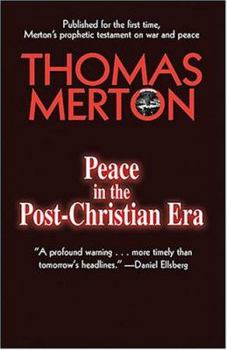
Peace in the Post-Christian Era


Select Format
Select Condition 
Book Overview
Writing at the height of the Cold War, Merton issued a passionate cry for sanity and a challenge to the idea that unthinkable violence can be squared with the Gospel of Christ. Censors of Merton's Trappist order blocked publication of this work, but forty years later, despite changing circumstances, his prophetic message remains eerily topical. At a time when the "war on terrorism" has replaced the struggle against communism, Merton's work continues to demonstrate the power and relevance of the Gospel in answering the most urgent challenges of our time.
Format:Paperback
Language:English
ISBN:1570755590
ISBN13:9781570755590
Release Date:September 2004
Publisher:Orbis Books
Length:165 Pages
Weight:0.61 lbs.
Dimensions:0.5" x 6.5" x 8.2"
Customer Reviews
2 ratings
Merton's Voice is Sorely Needed In Today's Post-Christian world
Published by Thriftbooks.com User , 18 years ago
This book is another of the most soul searing missives that I have had the good fortune of stumbling across. I read this one straight through. i would have done it in one sitting if I didn't have responsibilities that distracted me from it. This is one of those books that, although written decades ago, is still relevant, fresh and much needed in the toxic political and turbulent geopolitical world today. I have been a casual admirer of merton's writing for a while- but this book made so much sense to me that I now have tremendous respect for his wit and reason. The likes of him is direly needed in today's discourse of the faithful. The excerpt below a very strong commentary of the very factors in play yet today in the whole paradoxical, sometimes absurd conservative vs. liberal dialog: "It should be clear from the moral and mental confusion of our time that the present world crisis is something far more worse than merely political or economic conflict. It goes far deeper than ideologies. It is a crisis of man's spirit. It is a completely moral upheaval of the human race that has lost its religious and cultural roots. We do not really know half the causes of this upheaval. We cannot pretend to have full understanding of what is going on in ourselves and in our society. That is why our desperate hunger for clear and definite solutions sometimes leads us into temptation. We oversimplify. We seek the cause of evil and find it here or there in a particular nation, class, race, ideology system. And we discharge upon this scapegoat all the virulent force of our hatred, compounded with fear and anguish, striving to rid ourselves of our dread and of our guilt by destroying the object we have arbitrarily singled out as the embodiment of all evil. Far from curing us, this is only another paroxysm of which aggravates our sickness. The moral evil in the world is due to man's alienation from the deepest truth, from the springs of spiritual life within himself, to his alienation from God. Those who realize this and try desperately to persuade and enlighten their brothers. But we are in a radically different position from the first Christians, who revolutionized an essentially religious world of paganism with the message of a new religion that had never been heard of. We, on the contrary, live in an irreligious, post- Christian world in which the Christian message has been repeated over and over until it has come to seem empty of all intelligible content to those ears close to the word of God even before it has been uttered. In their minds Christian is no longer identified with newness and change, but only the static preservation of outworn structures. But why is this? Is it merely that the spiritual novelty Christianity has worn off in twenty centuries? That people have heard the gospel before and are tired of it? Or is it perhaps because for centuries the message has been belied by the conduct of Christians themselves?" I
Anti-War Treatise from 1962 Works Today
Published by Thriftbooks.com User , 21 years ago
This new work on Cold War politics was intended for publication in 1962. The story behind Thomas Merton's struggles with censorship within his Trappist community and the Church is told in 50-some pages of introductory material. That's interesting background, especially for those unfamiliar with Merton's life and work, but more fascinating is the ease with which one can apply his thoughts on peace in the sixties to war in 2004. Addressing nuclear war, Merton points out that the question is not what is going to happen to us but what are we going to do "and more cogently, What are our real intentions?" Of political slogans applied to issues of war, Merton says "poorly understood and emotionally loaded cliches can do enormous harm..." For Merton, war was "the `rider of the red horse' who is sent to prepare the destruction of the world (Rev 6:4) for `he has received power to take away peace from the earth and to make them all kill one another, and he has received a great sword.'"
Copyright © 2026 Thriftbooks.com Terms of Use
| Privacy Policy | Do Not
Sell/Share My Personal Information | Cookie Policy | Cookie Preferences | Accessibility Statement
ThriftBooks® and the ThriftBooks® logo are registered trademarks of Thrift Books Global, LLC
ThriftBooks® and the ThriftBooks® logo are registered trademarks of Thrift Books Global, LLC
