


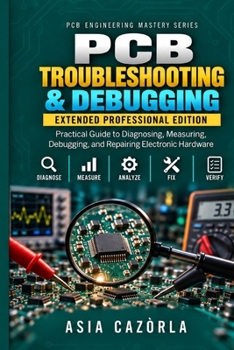
PCB Troubleshooting & Debugging Extended Edition: Practical Guide to Diagnosing, Measuring, Debugging, and Repairing Electronic Hardware

Troubleshoot PCB failures systematically-from the first symptom to the verified physical root cause.
PCB Troubleshooting & Debugging - Extended Professional Edition: Practical Guide to Diagnosing, Measuring, Debugging, and Repairing Electronic Hardware is a practical engineering reference for diagnosing faults in modern printed circuit boards and electronic systems.
This Extended Professional Edition expands the original ebook with deeper coverage of laboratory measurements, board bring-up, power failures, digital and analog debugging, high-speed interfaces, signal integrity, RF troubleshooting, EMI/EMC, manufacturing defects, and intermittent failures.
The book follows a structured workflow:
Symptom → Evidence → Hypothesis → Measurement → Localization → Root Cause → Corrective Action → Verification
Instead of replacing components by trial and error, you will learn how to identify the first abnormal condition, select the correct measurement, isolate the faulty subsystem, and correlate electrical evidence with the physical PCB structure responsible for the failure.
What You Will Learn- Systematic PCB troubleshooting and root-cause analysis
- Multimeter, bench power supply, and oscilloscope techniques
- Logic-analyzer and digital protocol troubleshooting
- Spectrum analyzer and VNA measurements
- Thermal, optical, X-ray, and visual inspection
- Safe first power-up and board bring-up
- Short-circuit and excessive-current localization
- Power-rail, regulator, sequencing, reset, and PDN debugging
- Analog, mixed-signal, noise, and stability troubleshooting
- MCU and FPGA hardware bring-up
- I C, SPI, UART, CAN, USB, Ethernet, memory, and high-speed interfaces
- Reflections, crosstalk, and return-path problems
- RF signal paths, PLLs, matching, gain, and RF stability
- EMI/EMC troubleshooting
- Soldering, BGA, QFN, via, fabrication, contamination, and corrosion defects
- Thermal, mechanical, and intermittent failures
- Design for Debug and Testability
- Troubleshooting decision trees and quick-reference tables
Realistic case studies show how engineers progress from an observed symptom to a verified root cause, including dead boards and shorted rails, switching-regulator instability, RF signal-path failures, and PCB-related hardware defects.
The central question is always:
What physical mechanism explains the measured behavior?
Part of the PCB Engineering Mastery SeriesThis book focuses on diagnosis, measurement, and failure isolation, while companion volumes provide deeper treatment of specific mechanisms.
PCB Manufacturing Defect Atlas expands manufacturing and assembly failures. Signal Integrity for PCB Designers covers transmission lines, reflections, crosstalk, vias, and high-speed channels. EMC & EMI PCB Design develops emissions, immunity, coupling, grounding, filtering, and return-current mechanisms. Other titles cover RF, power electronics, reliability, manufacturing, and advanced PCB engineering.
Who This Book Is ForIdeal for PCB designers, electronics and hardware engineers, RF and test engineers, technicians, advanced students, and professionals involved in bring-up, validation, manufacturing, repair, and failure analysis.
Whether the problem is a dead board, unstable power supply, intermittent interface, degraded high-speed channel, RF performance failure, or hidden manufacturing defect, the methodology remains:
Observe → Reproduce → Measure → Correlate → Localize → Understand → Correct → Verify
Stop guessing which component has failed. Follow the evidence until the symptom, physical mechanism, and corrective action tell the same story.
Customer Reviews
ThriftBooks ® and the ThriftBooks ® logo are registered trademarks of Thrift Books Global, LLC
