


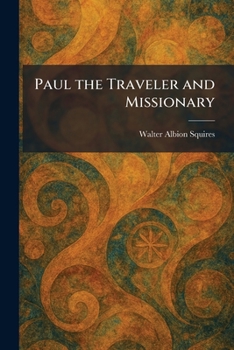
Paul the Traveler and Missionary

"Paul the Traveler and Missionary" is an insightful exploration of the life, ministry, and extensive journeys of the Apostle Paul. Written with a focus on Paul's role as the preeminent pioneer of the early Christian movement, the work traces his transformation from a persecutor of the church to its most tireless messenger. Walter Albion Squires provides a detailed account of the geographical and spiritual landscape of the first-century Mediterranean world, illustrating the challenges and triumphs Paul faced as he established early Christian communities across Asia Minor and Europe.
The narrative emphasizes Paul's missionary strategy, his unwavering commitment to his calling, and the enduring impact of his letters on Christian theology and practice. This volume serves as both a historical record of Paul's travels and a guide for understanding the expansion of the faith during its foundational years. Readers will find a clear, accessible examination of the biblical narrative that highlights the courage and resilience of one of history's most influential figures. "Paul the Traveler and Missionary" remains a valuable resource for students of the Bible, church historians, and anyone seeking a deeper understanding of the New Testament's dynamic origins.
This work has been selected by scholars as being culturally important, and is part of the knowledge base of civilization as we know it. This work was reproduced from the original artifact, and remains as true to the original work as possible. Therefore, you may see the original copyright references, library stamps (as most of these works have been housed in our most important libraries around the world), and other notations in the work.
This work is in the public domain in the United States of America, and possibly other nations. Within the United States, you may freely copy and distribute this work, as no entity (individual or corporate) has a copyright on the body of the work.
As a reproduction of a historical artifact, this work may contain missing or blurred pages, poor pictures, errant marks, etc. Scholars believe, and we concur, that this work is important enough to be preserved, reproduced, and made generally available to the public. We appreciate your support of the preservation process, and thank you for being an important part of keeping this knowledge alive and relevant.
Customer Reviews
ThriftBooks ® and the ThriftBooks ® logo are registered trademarks of Thrift Books Global, LLC
