


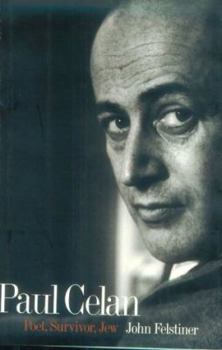
Paul Celan: Poet, Survivor, Jew

Select Format
Select Condition 
Book Overview
Paul Celan, Europe's most compelling postwar poet, was a German-speaking, East European Jew. His writing exposes and illumines the wounds that Nazi destructiveness left on language. John Felstiner's... This description may be from another edition of this product.
Format:Hardcover
Language:English
ISBN:0300060688
ISBN13:9780300060683
Release Date:April 1995
Publisher:Yale University Press
Length:366 Pages
Weight:1.43 lbs.
Dimensions:9.5" x 1.3" x 6.3"
Related Subjects
Arts & Literature Authors Biographical Biographies Biographies & History Biography & History Ethnic & National German History History & Criticism Jewish Literary Criticism Literary Criticism & Collections Literature & Fiction Modern (16th-21st Centuries) Movements & Periods Poetry World LiteratureCustomer Reviews
4 ratings
Black Milk of Daybreak
Published by Thriftbooks.com User , 19 years ago
Paul Celan was born into what soon became the wrong place and time. His family were German-speaking Jews from the eastern reach of the Austrian Empire. They lived in Czernowitz, capital of the Bukovina region, which passed to Romania just before Celan's birth in 1920. After a nine-month visit to his uncle in Paris where he was exposed to the Surrealists' influence in 1938, then his return to Czernowitz where his studies were interrupted by Soviet and then German occupation in 1940 and 1941, after forced labor in Romania's western mountains, his parents' deportation and death in German-occupied Ukraine, after the Red Army's return in 1944, Celan left home for Bucharest and then Vienna, where he first attracted recognition as a German-speaking poet, and in 1948 he settled in Paris. There he found a haven of sort at the Ecole Normale Superieure, where he taught German language and literature to generations of students (some of whom later contributed to his posthumous fame) and pursued his vocation as a poet in exile, estranged from his German mother tongue and survivor of a world that no longer was. Coming from a homeland that hardly existed anymore, writing for a German audience that he did not live among or trust, residing in France yet undervalued there, Paul Celan's native tongue itself was the only nation he could claim. Yet his relation to the German language was itself problematic, for the Nazis had abused and contaminated the words that once belonged to Goethe and Holderlin. Celan's austere idiom, mindful of death and horror, is rooted in his struggle to realize--by way of uninnocent language--"that which happened", the understatement he used to designate events of 1933-45. As he put it when receiving the City of Bremen's prize for his work in 1958, his language had to "pass through the thousand darknesses of deathbringing speech. It passed through and gave back no words for that which happened; yet it passed through this happening. Passed through and could come to light again, `enriched' by all this." The biographer gives detailed accounts of several episodes that took a heavy toll on the poet's sensitive feelings: the accusation of plagiarism that accompanied the publication of his first volume in France and that was to resurface later in his carrier; his almost paranoid belief that Nazism was again on the rise in post-war Germany and that Neo-Nazis were orchestrating a machination against him ("you can hardly imagine how things really look again in Germany," he wrote to a friend in 1960.) Paul Celan refused to submit a poem to Martin Heidegger for a Festschrift on his seventieth birthday, mindful of the philosopher's past complicity with Nazism and his enduring failure to recant after the war, but he nonetheless signed the Black Forest hermit's guestbook "with a hope for a coming word in the heart" during a visit to Todtnauberg in 1967. Recognition came late, and for much of his life was confined to the German-speaking world. When a
Crucial for understanding Celan
Published by Thriftbooks.com User , 25 years ago
Todesfuege (Death Fuge) is Celan's most famous poem, although he wrote it when he was only 24. Although it might seem cryptic, it is quite accessible in comparison with his later poems. Felsteiner does an excellent job of helping the reader to understand what Celan must have been like and further allows insight into his poetry in a straightforward, readable way. Because Celan is so difficult to understand, many critics, including Derrida, tend to interpret him in their own images.Felsteiner, on the other hand, is more concerned with portraying Celan accurately than using him as a platform to promote his own agendas. I would strongly recommend this book as an introduction to Celan.
Somebody Take a Picture
Published by Thriftbooks.com User , 26 years ago
I appreciate this book most for its study of the relationship between Paul Celan and his most famous poem, "Deathfugue." Before the English translation of that poem in this book is a photograph with the caption, "Orchestra playing 'Death Tango' in Janowska Road Camp, Lvov, ca. 1942." Prisoners used that term "for whatever music was being played when the Germans took a group out to be shot." (p. 30) Before reading this poem, I had read that it was impossible to get permission from the holder of the copyright to translate it into English and publish it, even if an American expert wanted to call it the best poem that had been written in the German language since World War II. The poem may have more meaning for those who already know what it means, and who would not be puzzled by, "We shovel a grave in the air there you won't lie too cramped."
A must-read
Published by Thriftbooks.com User , 26 years ago
This is one of the most powerful books imaginable, touching chords in the human heart that we would often choose to ignore. It is the story of a man whose courage and creativity helped him communicate truth in a world that was desperate to silence his voice. Please read this book....it will change everything.
Copyright © 2026 Thriftbooks.com
Terms of Use | Privacy Policy | Do Not Sell/Share My Personal Information | Cookie Policy | Cookie Preferences | Accessibility Statement
ThriftBooks ® and the ThriftBooks ® logo are registered trademarks of Thrift Books Global, LLC
ThriftBooks ® and the ThriftBooks ® logo are registered trademarks of Thrift Books Global, LLC
