


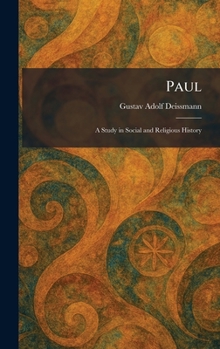
Paul: A Study in Social and Religious History

"Paul: A Study in Social and Religious History" is a landmark exploration of the life and legacy of the Apostle Paul, written by the renowned scholar Gustav Adolf Deissmann. This work shifts the focus from abstract theological interpretation to a grounded historical and social analysis of Paul as a human figure situated firmly within the context of the first-century Mediterranean world.
Deissmann reconstructs the environment of early Christianity by drawing on linguistic and archaeological evidence, arguing that Paul's writings are best understood as non-literary letters reflective of common daily life rather than formal dogmatic tracts. By placing Paul within the socio-economic realities of the Greco-Roman era, the book provides deep insights into the "primitive" Christianity that emerged from the urban centers of the East. Readers will find a compelling portrait of a man whose religious experiences and missionary travels bridged cultures and laid the foundations for a global faith.
This study is an invaluable resource for students of the New Testament, historians of the ancient world, and anyone interested in the intersection of social history and religious thought. It continues to be celebrated for its humanizing perspective on one of history's most influential religious figures and its rigorous attention to the cultural landscape of the early church.
This work has been selected by scholars as being culturally important, and is part of the knowledge base of civilization as we know it. This work was reproduced from the original artifact, and remains as true to the original work as possible. Therefore, you may see the original copyright references, library stamps (as most of these works have been housed in our most important libraries around the world), and other notations in the work.
This work is in the public domain in the United States of America, and possibly other nations. Within the United States, you may freely copy and distribute this work, as no entity (individual or corporate) has a copyright on the body of the work.
As a reproduction of a historical artifact, this work may contain missing or blurred pages, poor pictures, errant marks, etc. Scholars believe, and we concur, that this work is important enough to be preserved, reproduced, and made generally available to the public. We appreciate your support of the preservation process, and thank you for being an important part of keeping this knowledge alive and relevant.
Customer Reviews
ThriftBooks® and the ThriftBooks® logo are registered trademarks of Thrift Books Global, LLC
