


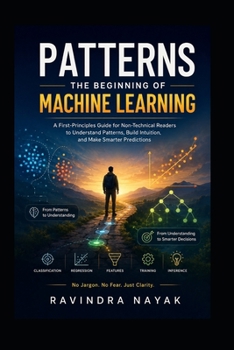
Patterns: The Beginning of Machine Learning (THE SUPER AGENT JOURNEY From Absolute Zero to AI Orchestrator)
No Customer Reviews

Machine learning can feel as though everyone else entered the room before you. The language arrives quickly-features, targets, classification, regression, training, inference, probability, thresholds, precision, recall-and suddenly a subject built from understandable ideas can sound like a wall of technical vocabulary.
Patterns: The Beginning of Machine Learning starts somewhere more useful: with the patterns you already notice in ordinary life. A bus tends to arrive around the same time. Demand changes with weather. Some examples belong together. Some numbers rise when another quantity changes. These familiar observations become the foundation for understanding what a machine-learning model is actually trying to do.
Written for non-technical readers, this book builds the subject from first principles and adds mathematics only when the meaning is already clear. You will learn why examples matter, how features describe them, what a target is, how classification differs from regression, why training is different from inference, and why a model must be tested on cases that did not teach it. From there, the journey deepens into loss and correction, probability and confidence, thresholds and consequences, model families such as linear models, decision trees, nearest neighbours and ensembles, and the practical meaning of precision, recall, robustness and distribution shift.
The goal is not to make machine learning look simple by hiding its difficulty. The goal is to make complexity visible in layers. Every formula is connected to a human question. Every metric is connected to the mistake it measures. Every model is treated as a useful pattern-maker with assumptions and limits-not as magic.
A final Value Edition turns the book into an active learning experience. You will rebuild the ideas from memory, practise no-fear mathematics, compare model families, diagnose assumptions, turn mistakes into maps, break complex problems into smaller decisions, and use a first-principles toolkit to design a prediction problem before reaching for an algorithm.
If you want to understand machine learning without beginning with code-and if you want enough conceptual confidence to follow modern AI conversations with better judgment-this book is designed to give you a foundation you can carry forward.
Patterns: The Beginning of Machine Learning starts somewhere more useful: with the patterns you already notice in ordinary life. A bus tends to arrive around the same time. Demand changes with weather. Some examples belong together. Some numbers rise when another quantity changes. These familiar observations become the foundation for understanding what a machine-learning model is actually trying to do.
Written for non-technical readers, this book builds the subject from first principles and adds mathematics only when the meaning is already clear. You will learn why examples matter, how features describe them, what a target is, how classification differs from regression, why training is different from inference, and why a model must be tested on cases that did not teach it. From there, the journey deepens into loss and correction, probability and confidence, thresholds and consequences, model families such as linear models, decision trees, nearest neighbours and ensembles, and the practical meaning of precision, recall, robustness and distribution shift.
The goal is not to make machine learning look simple by hiding its difficulty. The goal is to make complexity visible in layers. Every formula is connected to a human question. Every metric is connected to the mistake it measures. Every model is treated as a useful pattern-maker with assumptions and limits-not as magic.
A final Value Edition turns the book into an active learning experience. You will rebuild the ideas from memory, practise no-fear mathematics, compare model families, diagnose assumptions, turn mistakes into maps, break complex problems into smaller decisions, and use a first-principles toolkit to design a prediction problem before reaching for an algorithm.
If you want to understand machine learning without beginning with code-and if you want enough conceptual confidence to follow modern AI conversations with better judgment-this book is designed to give you a foundation you can carry forward.
Format:Paperback
Language:English
ISBN:B0HFG4QMVH
ISBN13:9798192972809
Release Date:August 2026
Publisher:Independently published
Length:291 Pages
Weight:0.78 lbs.
Dimensions:9.0" x 0.7" x 6.0"
Customer Reviews
0 rating
Copyright © 2026 Thriftbooks.com
Terms of Use | Privacy Policy | Do Not Sell/Share My Personal Information | Cookie Policy | Cookie Preferences | Accessibility Statement
ThriftBooks ® and the ThriftBooks ® logo are registered trademarks of Thrift Books Global, LLC
ThriftBooks ® and the ThriftBooks ® logo are registered trademarks of Thrift Books Global, LLC
