


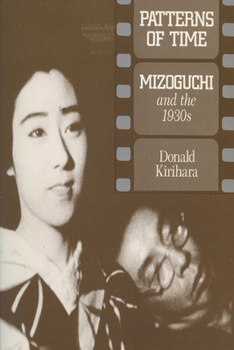
Patterns Of Time: Mizoguchi And The 1930S (Wisconsin Studies in Film)
No Customer Reviews

Although Kenji Mizoguchi is one of the three most important Japanese directors (along with Yasujiro Ozu and Akira Kurosawa), there has been no systematic critical study of his work in English. Correcting this omission, Donald Kirihara examines in extraordinary detail the brilliant early works of one of the world's great film directors, offering a sensitive analysis of his career.
The book targets a key phase of Mizoguchi's career, the 1930s. It was in that period that conditions within the Japanese film industry allowed Mizoguchi more freedom to experiment with film style and narrative structure. Kirihara analyzes the formal and stylistic components of four of Mizoguchi's films, The Downfall of Osen (1935), Naniwa Elegy (1936), Sisters of the Gion (1936), and The Story of the Last Chrysanthemum (1939), while considering the historical context in which they were produced and consumed.
Using scores of frame enlargements, drawing from a variety of historical sources, and integrating concepts from contemporary film theory, Kirihara proposes a new way of understanding Mizoguchi's films, arguing that at the heart of Mizoguchi's brilliance as a filmmaker is an obsessive need to challenge spectators, implicating them in the production of meaning through the dynamic manipulation of spatio-temporal relations. The result is a film style that self-consciously leads, frustrates, and surprises.
Kirihara's exploration of Mizoguchi within his national and cultural context marks a new step forward in the integration of film theory, historical research, and auteur criticism. He offers what are likely to remain the definitive readings of these four films.
The book targets a key phase of Mizoguchi's career, the 1930s. It was in that period that conditions within the Japanese film industry allowed Mizoguchi more freedom to experiment with film style and narrative structure. Kirihara analyzes the formal and stylistic components of four of Mizoguchi's films, The Downfall of Osen (1935), Naniwa Elegy (1936), Sisters of the Gion (1936), and The Story of the Last Chrysanthemum (1939), while considering the historical context in which they were produced and consumed.
Using scores of frame enlargements, drawing from a variety of historical sources, and integrating concepts from contemporary film theory, Kirihara proposes a new way of understanding Mizoguchi's films, arguing that at the heart of Mizoguchi's brilliance as a filmmaker is an obsessive need to challenge spectators, implicating them in the production of meaning through the dynamic manipulation of spatio-temporal relations. The result is a film style that self-consciously leads, frustrates, and surprises.
Kirihara's exploration of Mizoguchi within his national and cultural context marks a new step forward in the integration of film theory, historical research, and auteur criticism. He offers what are likely to remain the definitive readings of these four films.
Format:Paperback
Language:English
ISBN:0299132447
ISBN13:9780299132446
Release Date:June 1992
Publisher:University of Wisconsin Press
Length:240 Pages
Weight:1.15 lbs.
Dimensions:9.5" x 0.5" x 9.5"
Customer Reviews
0 rating
Copyright © 2026 Thriftbooks.com
Terms of Use | Privacy Policy | Do Not Sell/Share My Personal Information | Cookie Policy | Cookie Preferences | Accessibility Statement
ThriftBooks ® and the ThriftBooks ® logo are registered trademarks of Thrift Books Global, LLC
ThriftBooks ® and the ThriftBooks ® logo are registered trademarks of Thrift Books Global, LLC
