


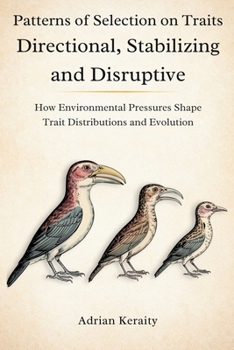
Patterns of Selection on Traits Directional, Stabilizing and Disruptive: How Environmental Pressures Shape Trait Distributions and Evolution

Patterns of Selection on Traits explains how evolution reshapes populations by acting on trait distributions over time. Instead of treating selection as a vague pressure or a story of winners and losers, this book shows how uneven reproductive outcomes shift, stabilize, or split traits across generations.
You will learn how directional, stabilizing, and disruptive selection work as sorting processes, not intentions. The focus is on who leaves descendants, under what recurring conditions, and how those outcomes shape population patterns, rather than on averages or simplified narratives.
Inside, you will find:
Clear explanations of directional selection, including early signals such as tail trimming, skew, cohort differences, and variance changing before the meanA precise treatment of stabilizing selection as an active process that maintains traits by repeatedly removing extremesAn in-depth look at disruptive selection and divergence, showing how multiple successful trait strategies can persist without immediate speciationExplanations of overshoot, stalling, and reversal, and why traits can move, pause, or reverse when conditions changeCareful discussion of population size, sampling effects, time lags, tradeoffs, and hidden costs in real evolutionary systemsThe book includes black-and-white illustrations and diagrams using well-known biological examples to clarify selection patterns and trait distributions.
If you want to understand why some traits move, why others stay stable, and why populations sometimes maintain more than one successful form at once, this book provides a framework that remains reliable even when biological reality is messy.Customer Reviews
ThriftBooks ® and the ThriftBooks ® logo are registered trademarks of Thrift Books Global, LLC
