


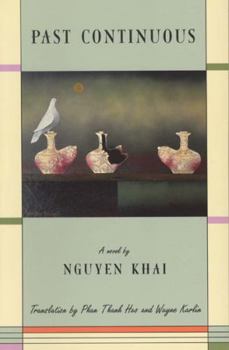
Past Continuous

Nguyen Khai's documentary novel, Past Continuous, published in the early 1980s before the "doi moi" policy was introduced, gives a fascinating inside view of North Vietnamese views and strategies during the American War in Vietnam. As the three narrators exchange reminiscences, we not only learn about the inner-workings of the liberation movement, but we also see the tensions that developed afterward in their post-war society. The novel dramatizes the histories, adventures, and emotions of three extraordinary people-- a secret agent, a female battalion commander, and a Catholic priest who supported the revolution. In Nguyen Khai, we have a Vietnamese Graham Greene exploring the revolution through the minds of three very different consciousnesses.
Format:Paperback
Language:English
ISBN:1880684780
ISBN13:9781880684788
Release Date:October 2001
Publisher:Curbstone Press
Length:190 Pages
Weight:0.50 lbs.
Dimensions:0.5" x 5.5" x 8.4"
Customer Reviews
1 rating
A Faulknerian view from Vietnam...
Published by Thriftbooks.com User , 16 years ago
Nguyen Khai explains his title in the prologue: "But maybe we can regard time, past and present, as coexisting, forever entwined. The past continuous." Which is certainly a good reformulation of William Faulkner's dictum: "The past is not dead; it is not even the past." The author wrote what is described as a "documentary novel" before "doi moi," (the renovation), in 1986, which open Vietnam to an economic restructuring of their society. The pre- doi moi period lasted a decade, which encompassed the heady days of victory and reunification of Vietnam, but also the terrible grim work of rebuilding their country after 30 years of war, which involved immense physical and human destruction. The Vietnamese were hobbled by a lack of resources, exacerbated by an economic boycott against it led by the United States, and they were smothered by the rigidity of a communist orthodoxy in economic matters. There was also rigidity in thought; an important point to remember in reading Nguyen's novel: the issues which could be broached, and those that had to remain un-discussed. Still, despite those constraints, the author does a superb job in depicting numerous aspects of the war, and its immediate post-war period, from the Vietnamese perspective. The central structure is the friendship between three individuals that serve as prototypes for larger trends with Vietnam. There is Vinh, the "worker priest," who is seeking justice for the poorer elements in the society, and is often at odds with the orthodoxy of the Vatican. Ba Hue is a female former battalion commander during the war. Finally, there is Quan, who is directly modeled on one of the classic double-agents of all time, Pham Xuan An. (A factual description of his life is available at:Perfect Spy: The Incredible Double Life of Pham Xuan An, Time Magazine Reporter and Vietnamese Communist Agent). The three have an annual reunion in what was once called the Iron Triangle, in a town near Chu Chi. There are several other characters, perhaps the most memorable is Hai Rieng, whose life has been dedicated to the care of rubber trees, starting during the days when it was a French plantation, through the entire American war period, and finally to help restore it after it had become a State-run plantation. There were numerous insights into the human condition worth noting. The author describes Ba Hue as being beautiful, and says: "She belied the old cliché that only ugly women became revolutionaries, women who couldn't find a man to love them and therefore displaced their passion into politics; women who couldn't dominate men with beauty and so felt a need to dominate them with power." And a message to all religious leaders, of whatever faith: "Priests must tend to the souls of their flocks not as police but as artists." Another message for those gaining in years: "Old people stay healthiest when they play with children." Despite the numerous books I've already read about Vietnam, there is still more to learn. I
Copyright © 2026 Thriftbooks.com
Terms of Use | Privacy Policy | Do Not Sell/Share My Personal Information | Cookie Notice | Cookie Preferences | Accessibility Statement
ThriftBooks ® and the ThriftBooks ® logo are registered trademarks of Thrift Books Global, LLC
ThriftBooks ® and the ThriftBooks ® logo are registered trademarks of Thrift Books Global, LLC
