


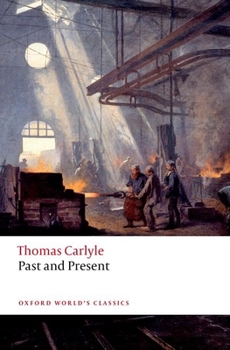
Past and Present

Select Format
Select Condition 
Book Overview
Thomas Carlyle's Past and Present (1843) was a prophetic warning of impending disaster for mid-Victorian Britain that was delivered in what the author described as a 'miraculous thunder-voice, from out of the centre of the world.' The impact of Carlyle's social criticism was immediate and profound, shaping debate about the 'The Condition of England' question well into the twentieth century and beyond, and serving as the moral foundation of the welfare state. His relentlessly abrasive and illuminating critique of industrial civilization generated a vast range of response both in England, Europe, and the United States. The writings of Matthew Arnold, John Stuart Mill, William Morris, John Henry Newman, and John Ruskin, as well as Henry David Thoreau, Ralph Waldo Emerson, and Walt Whitman, were saturated with imagery and ideas directly indebted to the book. Past and Present also provided novelists and poets with an enduring vision of the ubiquitous rot that lay at the heart of 'laissez-faire' England. The repercussions of Carlyle's unique analysis can be witnessed in the literary form and thematic content of such works as Charles Dickens's Christmas Carol (1843), Dombey and Son (1848), Bleak House (1852-53), and Hard Times (1854); Benjamin Disraeli's Sybil (1845); Elizabeth Gaskell's Mary Barton (1848) and North and South (1855); and Charles Kingsley's Alton Locke (1850). Poets such as Alfred Tennyson in Maud (1855), Elizabeth Barrett Browning in Aurora Leigh (1856), and Arthur Hugh Clough in The Latest Decalogue (1862) built a vocabulary that was steeped in the outrage and indignation of Carlyle's polemic. The artist Ford Madox Brown attempted in his painting Work (1852-65) to give visual testimony to the profound social schisms that Carlyle had exposed in Past and Present and to pay tribute to the 'Sage' who had 'moulded a nation to his pattern.'
Format:Paperback
Language:English
ISBN:0198841086
ISBN13:9780198841081
Release Date:July 2023
Publisher:Oxford University Press
Length:512 Pages
Weight:0.80 lbs.
Dimensions:1.5" x 5.2" x 7.4"
Customer Reviews
2 ratings
Salvation for the Western World
Published by Thriftbooks.com User , 24 years ago
A review of Carlyle's Past and Present written in Carlylese (he's much better at it than I am...)This book could change the whole Western world, if only men would read it, and believe it! -We could have several Utopias springing up in North American and throughout Europe within the space of five years! So here you are. In this work, Carlyle criticizes the social, economic, and political arrangements in England of the 1840s. I will not bother to explain what those arrangements were; I will only say that his criticism is as relevant to us now as it was to the people of his own time. My friends, very simply put, then as now, we have 'parted company with the eternal inner Facts of this Universe, and followed the outer transient Appearances thereof...[we] have forgotten the right Inner True, and taken up with the Outer Sham-true.' Yes Carlyle's English is a bit strange, but try not to be distracted by outer appearances, that is his point! In many aspects of our Western life, we have forgotten what is true and at the heart of the matter, and taken up with superficial nonsense. Let's begin with economics. In Carlyle's day, the Industrialists were trying their damnedest to figure out a way to make the production of cotton cheaper. This is a sham! Instead, figure out a way, with all your cotton cloth, to 'cover all the backs of England.' How like our present day Global Economists, wracking their brains trying to get the poor fools of the Third World to buy our products. Why don't they stop a moment and see if everyone at home is yet sufficiently provided for. Do your own fellow citizens need what you are producing, or have they enough of it, need they some other product which it is in your power to produce? And what is this of Advertising? Carlyle remembers a hat-maker who built a seven-foot hat of wood and plaster; wheeled it about the streets of London to attract customers to his shop. Does this improve the quality or utility of your hats, man, or does it only fool people into thinking that you have done honest work? I begin to think that more money is made in Advertising in these times of ours than in any other enterprise. What are our cities but places to tack up Billboards, to display Clothes in shop windows, to produce commercials for television, all to fool people into buying rubbish they don't need. Don't Advertise, Just Work! Religion? Why all the silly ceremonies, the controversies, feuding between different sects. Do we need absurd ceremonies and idolatrous rituals to believe in a Divine Power? True Religion is 'Moral Conscience, Inner Light' 'All Religion [is] here to remind us, better or worse, of what we already know, better or worse, of the quite infinite difference between a Good man, and a Bad, to bid us love infinitely the one, abhor infinitely the other, to strive infinitely to be the one, and not the other.' A Religious man is he who makes his whole life an appeal to Heaven, to Divine Justice, to Goodness, and who cannot be happy if he
The Best Carlyle- As lucid as Acid
Published by Thriftbooks.com User , 25 years ago
Widely known is the lucid and acid historic sense of Thomas Carlyle. This is what you will find in this book. More accessible than the monumental 'Sartor Resartus', but at the same high level. I strongly recomend that book as a way to enter into the vivid world of Carlyle.
Copyright © 2026 Thriftbooks.com Terms of Use
| Privacy Policy | Do Not
Sell/Share My Personal Information | Cookie Policy | Cookie Preferences | Accessibility Statement
ThriftBooks® and the ThriftBooks® logo are registered trademarks of Thrift Books Global, LLC
ThriftBooks® and the ThriftBooks® logo are registered trademarks of Thrift Books Global, LLC
