


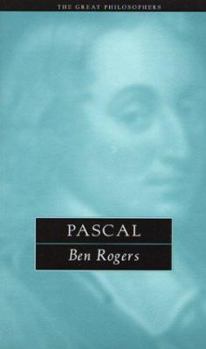
Pascal (The Great Philosophers Series)


Select Format
Select Condition 
Book Overview
First published in 1999. Routledge is an imprint of Taylor & Francis, an informa company. This description may be from another edition of this product.
Format:Paperback
Language:English
ISBN:0415923980
ISBN13:9780415923989
Release Date:July 1999
Publisher:Routledge
Length:64 Pages
Weight:0.20 lbs.
Dimensions:7.0" x 0.3" x 4.3"
Related Subjects
PhilosophyCustomer Reviews
1 rating
Wager it all on this brief book...
Published by Thriftbooks.com User , 17 years ago
What are the odds that God exists? Two to one? Ten to one? Does it matter? According to the 17th century philosopher and scientist Blaise Pascal, the odds matter less than the payoff. After all, believers who get the keys from St. Peter expect eternal life in paradise accompanied by their loved ones - assuming they also make it. If the choices are between heavenly bliss or the oblivion of nothingness do the odds even matter? Even with a thousand to one odds, wouldn't the rational person kneel, genuflect, and plead for salvation and forgiveness? "Pascal's Wager," despite its assumptions and flaws, has made this devout and somewhat conservative philosopher a household name. Apart from his famous and seductively juicy wager, Pascal also developed mathematical probability, built a very early adding machine, experimented with vacuums, and even had a computer language named after him (the most prestigious of 20th century honors). Philosophically, his unfinished posthumous collection of aphorisms, the Pensées ("thoughts"), reigns as his most influential work. This motley salad of ruminations, literally collated from bundles of paper, presents challenges not often presented in philosophy curriculum or in popular histories. Such original and iconoclastic thinking remains difficult to classify. Somehow this tiny 58-page book provides a tasty introduction to the breadth and depth of Pascal's masterpiece. Sometimes morsels contain entire meals. This near pamphlet focuses on Pascal's usurpation, outlined in the Pensées, of traditional dichotomies between "the philosophers" and "the people." By breaking down the arguments of each group Pascal hopes to wean readers towards the bliss of salvation embodied in Jesus Christ. Whether he succeeds remains beside the point. His method is fascinating. Essentially, he accepts two sides of a worn argument. So say "the philosophers": "the people" dabble in ephemeral, pointless trinkets of entertainment ("means not ends") while forsaking more meaningful "eternal" pursuits such as self-knowledge and facing life head on. In other words, they drown themselves in vain diversions ("divertissement"). Worse yet, they accept the hollow pretensions of the people that rule them. Don't they know the arbitrary nature of power? "The philosophers" thus scowl down at the mindless masses. Now the surprise. In a clever sleight-of-pen, Pascal accepts all of this but nonetheless defends the herd against the fulminations of the philosophers. People must weather the "brute facts of nature." These include power and subjugation in the name of peace and stability. In short, Pascal thinks the supposed sheepishness of the "mindless" crowds actually obscures rational behavior. The philosophers in their ivory towers miss the point. The people rationally accept the inequality of their world for the good of all. But Pascal nonetheless accepts that the people are vain, just as they philosophers charge. In the second leg of his argument, he accuses the p
Copyright © 2026 Thriftbooks.com Terms of Use
| Privacy Policy | Do Not
Sell/Share My Personal Information | Cookie Policy | Cookie Preferences | Accessibility Statement
ThriftBooks® and the ThriftBooks® logo are registered trademarks of Thrift Books Global, LLC
ThriftBooks® and the ThriftBooks® logo are registered trademarks of Thrift Books Global, LLC
