


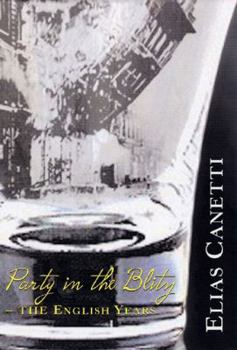
Party in the Blitz

Select Format
Select Condition 
Book Overview
A stunning and unexpected new volume of Elias Canetti's autobiography. A surprise gift to celebrate the Nobel Laureate's 100th birthday.
Nobel Prize winner Elias Canetti, at 85, beset by the desire to come to terms with his years of exile in Britain, wrote Party in the Blitz. He waited half a century to confront these memories, perhaps because "in order to be truthful, I should have to track down every needless humiliation I was offered in England, and relive it as the torture it was." Party in the Blitz dissects that torture with unrestrained acerbity, recounting the ordeal of being in a new country where not a soul knew his writing. But not one to be ignored, "the godmonster of Hempstead" (as John Bayley dubbed Canetti) soon knew everyone and everyone knew him. Enoch Powell, Bertrand Russell, Iris Murdoch, Empson, Wittgenstein, Kokoshka, Kathleen Raine, Henry Moore, Ralph Vaughn Williams: Canetti knew them all, and in Party in the Blitz he mercilessly rakes some of them over the coals. He detested T.S. Eliot and came to bitterly despise Iris Murdoch, with whom he had an affair: Every word of his devastating portrait of her quivers with rage. "He must have been a frequent party-goer," as Jeremy Adler remarks in his excellent afterword, "to judge by the well-informed distaste with which he recalls them." Gorgeously translated by Michael Hofmann, Party in the Blitz lives up to Canetti's injunction that "when you write down your life, every page should contain something no one has ever heard about."
Nobel Prize winner Elias Canetti, at 85, beset by the desire to come to terms with his years of exile in Britain, wrote Party in the Blitz. He waited half a century to confront these memories, perhaps because "in order to be truthful, I should have to track down every needless humiliation I was offered in England, and relive it as the torture it was." Party in the Blitz dissects that torture with unrestrained acerbity, recounting the ordeal of being in a new country where not a soul knew his writing. But not one to be ignored, "the godmonster of Hempstead" (as John Bayley dubbed Canetti) soon knew everyone and everyone knew him. Enoch Powell, Bertrand Russell, Iris Murdoch, Empson, Wittgenstein, Kokoshka, Kathleen Raine, Henry Moore, Ralph Vaughn Williams: Canetti knew them all, and in Party in the Blitz he mercilessly rakes some of them over the coals. He detested T.S. Eliot and came to bitterly despise Iris Murdoch, with whom he had an affair: Every word of his devastating portrait of her quivers with rage. "He must have been a frequent party-goer," as Jeremy Adler remarks in his excellent afterword, "to judge by the well-informed distaste with which he recalls them." Gorgeously translated by Michael Hofmann, Party in the Blitz lives up to Canetti's injunction that "when you write down your life, every page should contain something no one has ever heard about."
Format:Hardcover
Language:English
ISBN:0811216365
ISBN13:9780811216364
Release Date:September 2005
Publisher:New Directions Publishing Corporation
Length:249 Pages
Weight:1.04 lbs.
Dimensions:1.0" x 5.8" x 8.3"
Customer Reviews
1 rating
Canetti on Canetti
Published by Thriftbooks.com User , 19 years ago
I worship the late Elias Canetti. If nobody's heard of him, it's because we live in a culture that is fundamentally ignorant and under-educated. CROWDS AND POWER should be required reading in every school in this nation. Canetti's cycle of memoirs collectively comprises some of the best intellectual history of the twentieth century. PARTY IN THE BLITZ is the great man's last piss-blast in the face of a world he saw as hostile, stupid, and bent on destruction. The price of this book is justified alone by what Canetti says about T.S. Elliot. Elliot was one of the biggest anti-semites of all time, a cold prude who hated Jews, wrote bad pretentious poetry so arcane it needed footnotes (which he himself supplied), and desperately wanted to be an Englishman when in fact he was from St. Louis, Missouri. Canetti recognized what a sham Elliot was, and doesn't hesitate to let us know what Elliot was really like, through the eyes of an objective observer and not some fawning Catholic biographer. It's true that Canetti rips just about everyone to shreds in this book, but he has some amazingly kind things to say, too. He remembers, for instance, a mere street sweeper, who he talked to just in passing for many years, and whom he considered one of the most intelligent men he ever met. Canetti was a man who refused to suffer fools; he despised airs and pretentiousness. He was probably one of the most intelligent men of his age, which was almost certainly his great curse. He saw through the masks people wear, the illusions they use to disguise their flaws and insecurities, with ease. It was this great lucidity of his, this ability to perceive and understand things as they really are, that made him impatient, and ultimately, incredibly bitter.
Copyright © 2026 Thriftbooks.com Terms of Use
| Privacy Policy | Do Not
Sell/Share My Personal Information | Cookie Policy | Cookie Preferences | Accessibility Statement
ThriftBooks® and the ThriftBooks® logo are registered trademarks of Thrift Books Global, LLC
ThriftBooks® and the ThriftBooks® logo are registered trademarks of Thrift Books Global, LLC
