


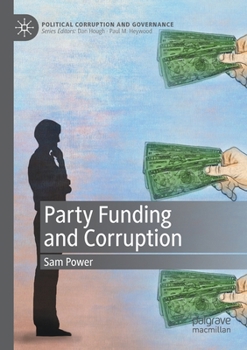
Party Funding and Corruption
No Customer Reviews

Select Format
Select Condition 
Book Overview
This book systematically explores the relationship between party funding and corruption, and addresses fundamental concerns in the continued consideration of how democracy should function. The book analyses whether parties funded primarily through private donations are necessarily more corrupt than those funded by the state, and whether different types of corruption are evident in different funding regimes. Drawing on a comparison of Great Britain and Denmark, the author argues that levels of state subsidy are, in fact, unrelated to the type of corruption found. Subsidies are not a cure for corruption or, importantly, perceived corruption, so if they are to be introduced or sustained, this should be done for other reasons. Subsidies can, for example, be justified on grounds of public utility. Meanwhile, anti-corruption measures should focus on other regulations, but even then we should not expect such measures to impact on perceptions of corruption in the short term.
Format:Paperback
Language:English
ISBN:303037582X
ISBN13:9783030375829
Release Date:April 2021
Publisher:Palgrave MacMillan
Length:251 Pages
Weight:0.72 lbs.
Dimensions:0.6" x 5.8" x 8.3"
Customer Reviews
0 rating
Copyright © 2026 Thriftbooks.com
Terms of Use | Privacy Policy | Do Not Sell/Share My Personal Information | Cookie Policy | Cookie Preferences | Accessibility Statement
ThriftBooks ® and the ThriftBooks ® logo are registered trademarks of Thrift Books Global, LLC
ThriftBooks ® and the ThriftBooks ® logo are registered trademarks of Thrift Books Global, LLC
