


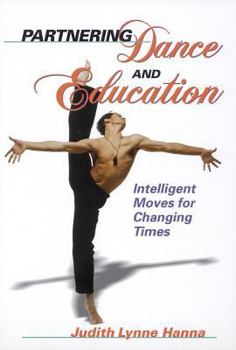
Partnering Dance and Education: Intelligent Moves Changing Times

Select Format
Select Condition 
Book Overview
Dance education is at a critical juncture in the United States. Even though it has gained wide acceptance as a valuable educational discipline and has achieved such victories as inclusion in the National Education Goals, its future remains uncertain. Educational reform, budget cuts, and conflicting views on the relevance of arts education all bring into question how--and if--dance should be taught in our schools. In Partnering Dance and Education , Dr. Judith Lynne Hanna presents a compelling argument for making dance central to every student's education. She examines current trends and issues in education to show how dance can be successfully justified and taught in today's changing educational environment. Rich with examples from arts magnet schools, arts organization offerings, dance company programs, public school instruction, and programs for at-risk youth, the book addresses difficult questions, including: - Is dance education in and of itself worthwhile? - What are the ways of providing dance education? - Who should teach dance in public schools? - Why and how should we connect dance to other bodies of knowledge? - What can be learned in, about, and through dance? - Does dance education benefit at-risk youth? - Do we teach gender roles in dance education? - What are the advantages and problems with cultural diversity in dance education? Divided into two parts, Partnering Dance and Education is full of information and insights that readers will find both illuminating and thought provoking. Part I recognizes dance as a discipline in its own right with a distinct body of knowledge. Chapters discuss the benefits and methods of providing dance education, ways dance education can develop within the education reform movement, and who should teach dance. Part II addresses how dance education, while meaningful in itself, has broader relevance. Chapters discuss how dance can be used to teach academic and workplace skills, help at-risk youth, promote national identity while preserving cultural diversity, and help people cope with stress. It explains how children's dance during free play can be used as a teaching tool, and it looks at the role of dance in teaching students about gender. A special appendix poses challenging discussion questions for students and teachers. An extensive dance resources appendix includes suggested readings, as well as the addresses and phone numbers of leading dance organizations, programs, and schools.
Format:Paperback
Language:English
ISBN:0880115114
ISBN13:9780880115117
Release Date:December 1998
Publisher:Human Kinetics
Length:272 Pages
Weight:1.00 lbs.
Dimensions:9.0" x 0.6" x 6.0"
Age Range:9 to 17 years
Grade Range:Grades 4 to 12
Customer Reviews
1 rating
All Dance Educators Should Read
Published by Thriftbooks.com User , 25 years ago
Partnering Dance and Education is one of the most relevant and informative publications for the dance teacher in America today. It gives a broad overview of the scenario faced by educators in both the academic and the studio settings and the networking which is needed between them. The benefits of dance in the academic settings as related to the studio owner are explored and defined in clear and concise language. Since this is an area to date unexplored and perceived by all dance teachers with hesitation, it is essential for informed decisions and liaisons between all who touch the dance students lives. Career opportunities, outreach programs, and "multiplication effects" are just a very few of the subjects addressed and explored by the author. The changing times of the dance world are viewed from a new and exciting perspective throughout the pages while acknowledgement and validation of the traditional forms of dance education are reviewed. With the inclusion of Dance in the federal government's Goals 2000 program for American Education, it is vital that all dance educators be aware of the innovations, aspirations and directions needed to bring dance into its well-deserved but long overdue recognition within the American culture and teaching systems.
Copyright © 2026 Thriftbooks.com Terms of Use
| Privacy Policy | Do Not
Sell/Share My Personal Information | Cookie Policy | Cookie Preferences | Accessibility Statement
ThriftBooks® and the ThriftBooks® logo are registered trademarks of Thrift Books Global, LLC
ThriftBooks® and the ThriftBooks® logo are registered trademarks of Thrift Books Global, LLC
