


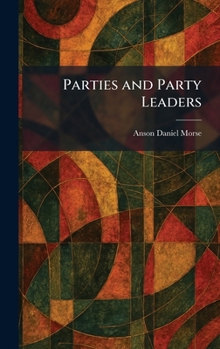
Parties and Party Leaders

"Parties and Party Leaders" is a profound exploration of the evolution and structural necessity of political parties within a democratic society. Written by historian Anson Daniel Morse, this work analyzes the essential functions of party systems, framing them as the primary mechanism through which the public will is translated into governmental action. Morse investigates the history of American political factions, examining how their development reflects the shifting values and priorities of the nation.
The text provides a rigorous analysis of the moral and social foundations of political organizations, arguing that parties are indispensable to the health of the state. Through a series of thoughtful essays, the author evaluates the qualities of effective party leadership and the ideological conflicts that have defined the American political landscape. Morse's insights into the nature of partisan dynamics and the role of the individual leader offer a timeless perspective on the complexities of representative government. This volume serves as an essential resource for those interested in political science, history, and the foundational principles of democracy, emphasizing the critical intersection between institutional theory and political practice.
This work has been selected by scholars as being culturally important, and is part of the knowledge base of civilization as we know it. This work was reproduced from the original artifact, and remains as true to the original work as possible. Therefore, you may see the original copyright references, library stamps (as most of these works have been housed in our most important libraries around the world), and other notations in the work.
This work is in the public domain in the United States of America, and possibly other nations. Within the United States, you may freely copy and distribute this work, as no entity (individual or corporate) has a copyright on the body of the work.
As a reproduction of a historical artifact, this work may contain missing or blurred pages, poor pictures, errant marks, etc. Scholars believe, and we concur, that this work is important enough to be preserved, reproduced, and made generally available to the public. We appreciate your support of the preservation process, and thank you for being an important part of keeping this knowledge alive and relevant.
Customer Reviews
ThriftBooks ® and the ThriftBooks ® logo are registered trademarks of Thrift Books Global, LLC
