


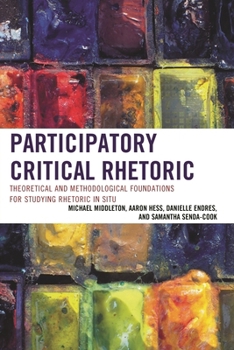
Participatory Critical Rhetoric: Theoretical and Methodological Foundations for Studying Rhetoric In Situ
No Customer Reviews

Select Format
Select Condition 
Book Overview
Increasingly, rhetorical scholars are using fieldwork and other ethnographic, performance, and qualitative methods to access, document, and analyze forms of everyday in situ rhetoric rather than using already documented texts. In this book, the authors argue that participatory critical rhetoric, as an approach to in situ rhetoric, is a theoretically, methodologically, and praxiologically robust approach to critical rhetorical studies. This book addresses how participatory critical rhetoric furthers understanding of the significant role that rhetoric plays in everyday life through expanding the archive of rhetorical practices and texts, emplacing rhetorical critics in direct conversation with rhetors and audiences at the moment of rhetorical invention, and highlighting marginalized voices that might otherwise go unnoticed. This book organizes the theoretical and methodological foundations of participatory critical rhetoric through four vectors that enhance conventional rhetorical approaches: 1) the political commitments of the critic; 2) rhetorical reflexivity and the role of the embodied critic; 3) emplaced rhetoric and the interplay between the field, text, and context; and 4) multiperspectival judgment that is informed by direct participation with rhetors and audiences. In addition to laying the groundwork and advocating for the approach, Participatory Critical Rhetoric also offers significant contributions to rhetorical theory and criticism more broadly by revisiting the field's understanding of core topics such as role of the critic, text/context, audience, rhetorical effect, and the purpose of criticism. Further, it enhances theoretical conversations about material rhetoric, place/space, affect, intersectional rhetoric, embodiment, and rhetorical reflexivity.
Format:Paperback
Language:English
ISBN:1498513824
ISBN13:9781498513821
Release Date:July 2017
Publisher:Lexington Books
Length:242 Pages
Weight:0.79 lbs.
Dimensions:0.6" x 6.0" x 9.0"
Customer Reviews
0 rating
Copyright © 2026 Thriftbooks.com Terms of Use
| Privacy Policy | Do Not
Sell/Share My Personal Information | Cookie Policy | Cookie Preferences | Accessibility Statement
ThriftBooks® and the ThriftBooks® logo are registered trademarks of Thrift Books Global, LLC
ThriftBooks® and the ThriftBooks® logo are registered trademarks of Thrift Books Global, LLC
