


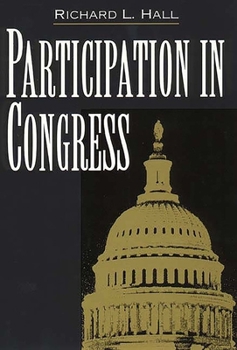
Participation in Congress


Select Format
Select Condition 
Book Overview
For every issue that arises on the legislative agenda, each member of Congress must make two decisions: What position to take and how active to be. The first has been thoroughly studied. But little is understood about the second. In this landmark book, a leading scholar of congressional studies draws on extensive interviews and congressional documents to uncover when and how members of congress participate at the subcommittee, committee, and floor stages of legislative decision making. Richard L. Hall develops an original theory to account for varying levels of participation across members and issues, within House and Senate, and across pre- and postreform periods of the modern Congress. By closely analyzing behavior on sixty bills in the areas of agriculture, human resources, and commerce, Hall finds that participation at each stage of the legislative process is rarely universal and never equal. On any given issue, most members who are eligible to participate forego the opportunity to do so, leaving a self-selected few to deliberate on the policy. These active members often do not reflect the values and interests evident in their parent chamber. A deeper understanding of congressional participation, the author contends, informs related inquiries into how well members of congress represent constituents' interests, what factors influence legislative priorities, how members gain legislative leverage on specific issues, and how well collective choice in Congress meets democratic standards of representative deliberation.
Format:Paperback
Language:English
ISBN:0300076517
ISBN13:9780300076516
Release Date:September 1998
Publisher:Yale University Press
Length:312 Pages
Weight:1.02 lbs.
Dimensions:0.7" x 6.1" x 9.2"
Customer Reviews
1 rating
can't buy votes, but can buy time
Published by Thriftbooks.com User , 24 years ago
Hall points out that while we like to assume that legislators can be bought -- that is, that political donations "buy" a vote on a given issue -- studies have rarely found any real link between a legislator's stand on an issue and the positions s/he takes. Indeed, interest groups often give a good deal of money to their friends: agricultural groups to Congressmen from farm states, for example. Why bother?The answer, Hall suggests, is that while Congressmen don't sell their vote, they do rent their time. Members can choose to participate, or not, in any number of arenas -- they only have so many hours in a day and need to choose which meetings to attend and when to speak up. So when deciding when they will go to a given subcommittee or offer a given amendment, they do take into account the strength and intensity of their various constituencies, including those who give money to their campaigns. It's an interesting and well-crafted account.This is hardly a perfect work (if only because through no fault of Hall's the Congress changed dramatically after 1994, when the GOP took control for the first time in 40 years), but it is a serious one; thus, with respect, the earlier posted review of this book is rather ludicrous. Hall refers to his own work in part because he has been in the forefront of work that explores the dynamics of Congressional behavior; using the first person is a welcome break from the ponderous royal "we" or stating things in the passive tense. It's not clear what statistics are meant to be in question. This book uses quantitative methods, themselves not universal in political science and certainly at times hard to understand. But this doesn't make them incorrect. Hall could do a better job translating his numbers into English, but serious readers need to do some of the work too.
Copyright © 2026 Thriftbooks.com Terms of Use
| Privacy Policy | Do Not
Sell/Share My Personal Information | Cookie Policy | Cookie Preferences | Accessibility Statement
ThriftBooks® and the ThriftBooks® logo are registered trademarks of Thrift Books Global, LLC
ThriftBooks® and the ThriftBooks® logo are registered trademarks of Thrift Books Global, LLC
