


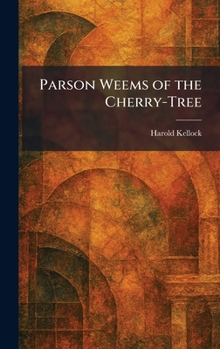
Parson Weems of the Cherry-Tree

"Parson Weems of the Cherry-Tree" is an engaging and insightful biographical study of Mason Locke Weems, one of the most colorful and influential figures in the development of early American mythology. Known primarily as the creator of the iconic legend of George Washington and the cherry tree, Weems was a complex individual who served as an ordained minister, a relentless book peddler, and a pioneering author of popular biographies intended for the masses.
Author Harold Kellock brings to life the vibrant world of the post-Revolutionary United States through the lens of Weems's itinerant career. The work explores how Weems navigated the backroads of the young republic, distributing literature that blended moral instruction with patriotic fervor. By examining the life of this charismatic storyteller, Kellock reveals the origins of some of America's most enduring cultural myths and the role they played in shaping the national character. This work is a valuable resource for those interested in the history of American publishing, the evolution of national legends, and the fascinating life of a man who bridged the gap between history and folklore. "Parson Weems of the Cherry-Tree" captures the spirit of a formative era through a man who was as much a salesman as he was a moralist.
This work has been selected by scholars as being culturally important, and is part of the knowledge base of civilization as we know it. This work was reproduced from the original artifact, and remains as true to the original work as possible. Therefore, you may see the original copyright references, library stamps (as most of these works have been housed in our most important libraries around the world), and other notations in the work.
This work is in the public domain in the United States of America, and possibly other nations. Within the United States, you may freely copy and distribute this work, as no entity (individual or corporate) has a copyright on the body of the work.
As a reproduction of a historical artifact, this work may contain missing or blurred pages, poor pictures, errant marks, etc. Scholars believe, and we concur, that this work is important enough to be preserved, reproduced, and made generally available to the public. We appreciate your support of the preservation process, and thank you for being an important part of keeping this knowledge alive and relevant.
Customer Reviews
ThriftBooks® and the ThriftBooks® logo are registered trademarks of Thrift Books Global, LLC
