


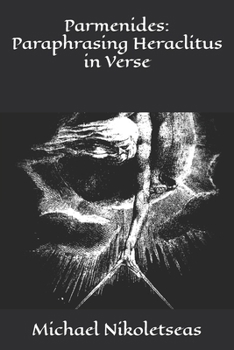
Parmenides: Paraphrasing Heraclitus in Verse
No Customer Reviews

"Parmenides: Paraphrasing Heraclitus in Verse" by Michael M. Nikoletseas
Harvard University Libraries.
Overview and Context
"Parmenides: Paraphrasing Heraclitus in Verse" by Michael M. Nikoletseas, published in 2015 (ISBN-13: 978-1517054151, ISBN-10: 151705415X), reinterprets the philosophical relationship between Heraclitus and Parmenides, two key pre-Socratic thinkers. Traditionally, Heraclitus is known for his doctrine of flux ("panta rhei," everything flows) and Parmenides for his emphasis on permanence and being, often seen as opposing views. Nikoletseas challenges this dichotomy, arguing that Parmenides extensively paraphrased and built upon Heraclitus's ideas, particularly the concept of "logos" as a formal system for understanding nature, transforming it into his own concept of "t e n" (Being). The book, spanning 159 pages, includes a preface, sections on key themes, paraphrasis of individual fragments, an epilogue, bibliography, and appendices with fragments of both philosophers. Evaluation and Critique Strengths
- **Textual Analysis**: The book's strength lies in its detailed comparison of fragments, providing specific examples like Parmenides 5 and Heraclitus 103, supporting the paraphrasing claim. This is valuable for scholars, as seen in its listing on PhilPapers ( Michael M. Nikoletseas, Parmenides: Paraphrasing Heraclitus in Verse] - **Interdisciplinary Approach**: Connecting ancient philosophy to modern science (e.g., Galileo, Kant) is innovative, appealing to historians of science, as noted on Academia.edu ( PDF] Parmenides: Paraphrasing Heraclitus in Verse]. - **Challenging Traditional Views**: Nikoletseas challenges the flux vs. permanence dichotomy, aligning with some scholarly views (e.g., Nehamas 2002, via Stanford Encyclopedia of Philosophy Heraclitus], suggesting more common ground Potential Criticism
- **Overstatement of Influence**: Some may argue Parmenides developed his own ideas, not merely paraphrasing, given traditional views of their opposition (e.g., Heraclitus vs. Parmenides: The Problem of Change]( The extent of influence remains debated.
- **Anachronistic Projections**: Projecting modern scientific concepts onto ancient texts could be seen as anachronistic, though Nikoletseas grounds claims in fragments, as seen on page 94. Relevance and Audience
The book is highly relevant for philosophers, classicists, and historians of science, particularly those interested in pre-Socratic thought and its scientific implications. Its dense scholarly style, with original Greek and fragment comparisons, may challenge lay readers, but the preface and epilogue provide accessible insights. It aligns with Nikoletseas's broader oeuvre, listed on Goodreads ( Books by Michael M. Nikoletseas]( suggesting a consistent focus on epistemology and natural science. Comparative Analysis
Compared to works like Kahn, C. H. (1979), "The Art and Thought of Heraclitus," which focuses on cosmology, Nikoletseas emphasizes epistemology, aligning with Heisenberg, W. (1959), "Physics and Philosophy," though the latter seeks analogies with modern physics. His approach is systematic, grouping fragments thematically, and his critique of Plato and Aristotle's influence echoes Graham, D. W. (2009), "Explaining the Cosmos." Conclusion
"Parmenides: Paraphrasing Heraclitus in Verse" is a significant scholarly contribution, offering a novel interpretation that challenges traditional views and bridges ancient philosophy with modern science. While not without controversy, particularly regarding the extent of Parmenides's dependence on Heraclitus, Nikoletseas's detailed analysis and interdisciplinary approach make it a valuable resource for academic audiences. It invites further exploration of pre-Socratic thought, reinforcing their enduring relevance.
.
Harvard University Libraries.
Overview and Context
"Parmenides: Paraphrasing Heraclitus in Verse" by Michael M. Nikoletseas, published in 2015 (ISBN-13: 978-1517054151, ISBN-10: 151705415X), reinterprets the philosophical relationship between Heraclitus and Parmenides, two key pre-Socratic thinkers. Traditionally, Heraclitus is known for his doctrine of flux ("panta rhei," everything flows) and Parmenides for his emphasis on permanence and being, often seen as opposing views. Nikoletseas challenges this dichotomy, arguing that Parmenides extensively paraphrased and built upon Heraclitus's ideas, particularly the concept of "logos" as a formal system for understanding nature, transforming it into his own concept of "t e n" (Being). The book, spanning 159 pages, includes a preface, sections on key themes, paraphrasis of individual fragments, an epilogue, bibliography, and appendices with fragments of both philosophers. Evaluation and Critique Strengths
- **Textual Analysis**: The book's strength lies in its detailed comparison of fragments, providing specific examples like Parmenides 5 and Heraclitus 103, supporting the paraphrasing claim. This is valuable for scholars, as seen in its listing on PhilPapers ( Michael M. Nikoletseas, Parmenides: Paraphrasing Heraclitus in Verse] - **Interdisciplinary Approach**: Connecting ancient philosophy to modern science (e.g., Galileo, Kant) is innovative, appealing to historians of science, as noted on Academia.edu ( PDF] Parmenides: Paraphrasing Heraclitus in Verse]. - **Challenging Traditional Views**: Nikoletseas challenges the flux vs. permanence dichotomy, aligning with some scholarly views (e.g., Nehamas 2002, via Stanford Encyclopedia of Philosophy Heraclitus], suggesting more common ground Potential Criticism
- **Overstatement of Influence**: Some may argue Parmenides developed his own ideas, not merely paraphrasing, given traditional views of their opposition (e.g., Heraclitus vs. Parmenides: The Problem of Change]( The extent of influence remains debated.
- **Anachronistic Projections**: Projecting modern scientific concepts onto ancient texts could be seen as anachronistic, though Nikoletseas grounds claims in fragments, as seen on page 94. Relevance and Audience
The book is highly relevant for philosophers, classicists, and historians of science, particularly those interested in pre-Socratic thought and its scientific implications. Its dense scholarly style, with original Greek and fragment comparisons, may challenge lay readers, but the preface and epilogue provide accessible insights. It aligns with Nikoletseas's broader oeuvre, listed on Goodreads ( Books by Michael M. Nikoletseas]( suggesting a consistent focus on epistemology and natural science. Comparative Analysis
Compared to works like Kahn, C. H. (1979), "The Art and Thought of Heraclitus," which focuses on cosmology, Nikoletseas emphasizes epistemology, aligning with Heisenberg, W. (1959), "Physics and Philosophy," though the latter seeks analogies with modern physics. His approach is systematic, grouping fragments thematically, and his critique of Plato and Aristotle's influence echoes Graham, D. W. (2009), "Explaining the Cosmos." Conclusion
"Parmenides: Paraphrasing Heraclitus in Verse" is a significant scholarly contribution, offering a novel interpretation that challenges traditional views and bridges ancient philosophy with modern science. While not without controversy, particularly regarding the extent of Parmenides's dependence on Heraclitus, Nikoletseas's detailed analysis and interdisciplinary approach make it a valuable resource for academic audiences. It invites further exploration of pre-Socratic thought, reinforcing their enduring relevance.
.
Format:Paperback
Language:English
ISBN:151705415X
ISBN13:9781517054151
Release Date:September 2015
Publisher:Createspace Independent Publishing Platform
Length:160 Pages
Weight:0.49 lbs.
Dimensions:0.3" x 6.0" x 9.0"
Related Subjects
PhilosophyCustomer Reviews
0 rating
Copyright © 2026 Thriftbooks.com Terms of Use
| Privacy Policy | Do Not
Sell/Share My Personal Information | Cookie Policy | Cookie Preferences | Accessibility Statement
ThriftBooks® and the ThriftBooks® logo are registered trademarks of Thrift Books Global, LLC
ThriftBooks® and the ThriftBooks® logo are registered trademarks of Thrift Books Global, LLC
