


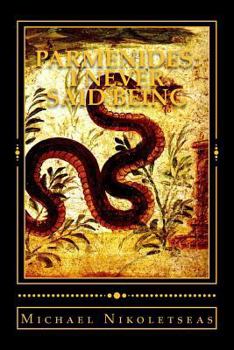
Parmenides: I never said Being
No Customer Reviews

"Parmenides: I Never Said Being* is a thought-provoking and original contribution to pre-Socratic scholarship. Nikoletseas' argument that Parmenides' *eon* refers to a methodological framework rather than an ontological "Being" challenges long-held assumptions and invites readers to view Parmenides as a pioneer of scientific inquiry. The book's strengths lie in its innovative thesis, scientific perspective, and close textual analysis, making it a valuable read for philosophers, classicists, and historians of science.. Michael M. Nikoletseas' *Parmenides: I Never Said Being* (2015) presents a bold and provocative reinterpretation of Parmenides' philosophical poem, challenging the traditional ontological reading that has dominated Western philosophy since Plato. ### Structure and Content
- **Preface**: Introduces the author's groundbreaking theses: that Heraclitus is a philosopher of stability (not change) and that Parmenides' *eon* denotes a method, not "Being." Nikoletseas positions his work as a continuation of his earlier studies (2013, 2015a, 2015b), emphasizing a scientific lens over traditional philosophical interpretations.
- **Peri Physeos Translation and Comments**: The core of the book, offering Nikoletseas' translations of Parmenides' fragments 1-8, accompanied by detailed commentary. Each fragment is analyzed to argue that *eon* refers to a "road" (*hodos*) or method (*methodos*), a cognitive framework for achieving a true representation of nature. The author deliberately avoids traditional scholarly interpretations, aiming for a "naive" reading that aligns with Parmenides' pre-philosophical context.
- **Epilogue**: Summarizes the argument, acknowledging the potential for controversy while inviting scholarly debate. Nikoletseas reiterates that *eon* aligns with Heraclitus' *logos*, a formal system for scientific inquiry.
- **Bibliography**: A comprehensive list of sources, including works by Aristotle, Heidegger, and modern scholars like Jonathan Barnes and Alexander Mourelatos, alongside Nikoletseas' own publications.
### Strengths
1. **Innovative Thesis**: Nikoletseas' reinterpretation of *t eon* as a method rather than "Being" is a daring departure from centuries of ontological readings. By framing Parmenides as a thinker concerned with epistemology and scientific methodology, the book challenges readers to reconsider the origins of Western philosophy and its relationship to natural science.
2. **Scientific Perspective**: The author's background in psychobiology and statistics informs his approach, lending a fresh, empirical lens to Parmenides' poem.
3. **Close Textual Analysis**: Nikoletseas' translations are meticulous, with careful attention to Greek terms like *hodos* (road), *methodos* (method), and *eon* (existing). His commentary highlights linguistic nuances, such as the shift from feminine (*eōn* as *hodos*) to neutral genders in Fragment 8, which he uses to argue against the "Being" interpretation.
4. **Engagement with Heraclitus**: The book situates Parmenides in dialogue with Heraclitus, proposing that Parmenides paraphrases and expands on Heraclitean *logos*. This contextualization enriches the argument, suggesting a continuity in pre-Socratic thought that is often overlooked.
5. **Accessible Style**: Despite its academic rigor, the book is concise and clearly written, making it approachable for readers unfamiliar with Parmenides or Greek philosophy. The laconic style aligns with the author's stated intent to avoid the "clandestine systems" of later philosophers. **Recommendation**: Recommended for readers interested in pre-Socratic philosophy, the history of science, or alternative readings of Parmenides. Pair with Jonathan Barnes' *The Presocratic Philosophers* for a balanced perspective.
- **Preface**: Introduces the author's groundbreaking theses: that Heraclitus is a philosopher of stability (not change) and that Parmenides' *eon* denotes a method, not "Being." Nikoletseas positions his work as a continuation of his earlier studies (2013, 2015a, 2015b), emphasizing a scientific lens over traditional philosophical interpretations.
- **Peri Physeos Translation and Comments**: The core of the book, offering Nikoletseas' translations of Parmenides' fragments 1-8, accompanied by detailed commentary. Each fragment is analyzed to argue that *eon* refers to a "road" (*hodos*) or method (*methodos*), a cognitive framework for achieving a true representation of nature. The author deliberately avoids traditional scholarly interpretations, aiming for a "naive" reading that aligns with Parmenides' pre-philosophical context.
- **Epilogue**: Summarizes the argument, acknowledging the potential for controversy while inviting scholarly debate. Nikoletseas reiterates that *eon* aligns with Heraclitus' *logos*, a formal system for scientific inquiry.
- **Bibliography**: A comprehensive list of sources, including works by Aristotle, Heidegger, and modern scholars like Jonathan Barnes and Alexander Mourelatos, alongside Nikoletseas' own publications.
### Strengths
1. **Innovative Thesis**: Nikoletseas' reinterpretation of *t eon* as a method rather than "Being" is a daring departure from centuries of ontological readings. By framing Parmenides as a thinker concerned with epistemology and scientific methodology, the book challenges readers to reconsider the origins of Western philosophy and its relationship to natural science.
2. **Scientific Perspective**: The author's background in psychobiology and statistics informs his approach, lending a fresh, empirical lens to Parmenides' poem.
3. **Close Textual Analysis**: Nikoletseas' translations are meticulous, with careful attention to Greek terms like *hodos* (road), *methodos* (method), and *eon* (existing). His commentary highlights linguistic nuances, such as the shift from feminine (*eōn* as *hodos*) to neutral genders in Fragment 8, which he uses to argue against the "Being" interpretation.
4. **Engagement with Heraclitus**: The book situates Parmenides in dialogue with Heraclitus, proposing that Parmenides paraphrases and expands on Heraclitean *logos*. This contextualization enriches the argument, suggesting a continuity in pre-Socratic thought that is often overlooked.
5. **Accessible Style**: Despite its academic rigor, the book is concise and clearly written, making it approachable for readers unfamiliar with Parmenides or Greek philosophy. The laconic style aligns with the author's stated intent to avoid the "clandestine systems" of later philosophers. **Recommendation**: Recommended for readers interested in pre-Socratic philosophy, the history of science, or alternative readings of Parmenides. Pair with Jonathan Barnes' *The Presocratic Philosophers* for a balanced perspective.
Format:Paperback
Language:English
ISBN:1518829015
ISBN13:9781518829017
Release Date:October 2015
Publisher:Createspace Independent Publishing Platform
Length:66 Pages
Weight:0.22 lbs.
Dimensions:0.1" x 6.0" x 9.0"
Related Subjects
PhilosophyCustomer Reviews
0 rating
Copyright © 2025 Thriftbooks.com
Terms of Use | Privacy Policy | Do Not Sell/Share My Personal Information | Cookie Policy | Cookie Preferences | Accessibility Statement
ThriftBooks ® and the ThriftBooks ® logo are registered trademarks of Thrift Books Global, LLC
ThriftBooks ® and the ThriftBooks ® logo are registered trademarks of Thrift Books Global, LLC
