


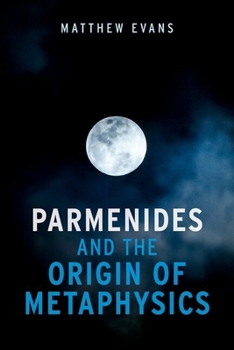
Parmenides and the Origin of Metaphysics
No Customer Reviews

Parmenides and the Origin of Metaphysics offers a novel and comprehensive solution to one of the oldest interpretive puzzles in the history of ancient Greek philosophy: the so-called "problem of the Doxa." This puzzle arises out of an apparent conflict between the main part of Parmenides' poem, called "the Aletheia," and the cosmological part, called "the Doxa." Whereas in the Aletheia he seems to argue that nothing is generated, divided, or changing, in the Doxa he seems to presuppose that lots of things are. Over the last century, the standard solution to this puzzle has been to marginalize the Doxa, and hold that, according to Parmenides, the theory presented there is logically or rationally incoherent. Matthew Evans defends an alternative solution: the two parts of the poem are not at odds with each other, because each of them is about a distinct kind of thing. Evans argues that the cosmological part is about the things we encounter in the world around us, while the main part is about the underlying nature or reality of such things. By working carefully and systematically through the poem's most challenging passages, the book shows how this alternative solution makes surprisingly good sense. It also shows, at a deeper level, how continuous the discipline of metaphysics has been, from the beginning, with the theory-building enterprise of the empirical sciences.
Format:Hardcover
Language:English
ISBN:0197834884
ISBN13:9780197834886
Release Date:June 2026
Publisher:Oxford University Press
Length:376 Pages
Related Subjects
PhilosophyCustomer Reviews
0 rating
Copyright © 2026 Thriftbooks.com Terms of Use
| Privacy Policy | Do Not
Sell/Share My Personal Information | Cookie Policy | Cookie Preferences | Accessibility Statement
ThriftBooks® and the ThriftBooks® logo are registered trademarks of Thrift Books Global, LLC
ThriftBooks® and the ThriftBooks® logo are registered trademarks of Thrift Books Global, LLC
