


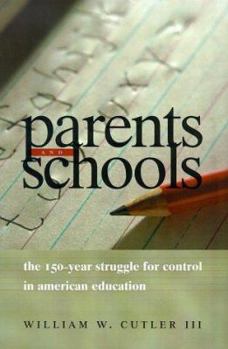
Parents and Schools: The 150-Year Struggle for Control in American Education


Who holds ultimate authority for the education of America's children--teachers or parents? Although the relationship between home and school has changed dramatically over the decades, William Cutler's fascinating history argues that it has always been a political one, and his book uncovers for the first time how and why the balance of power has shifted over time. Starting with parental dominance in the mid-nineteenth century, Cutler chronicles how schools' growing bureaucratization and professionalization allowed educators to gain increasing control over the schooling and lives of the children they taught. Central to his story is the role of parent-teacher associations, which helped transform an adversarial relationship into a collaborative one. Yet parents have also been controlled by educators through PTAs, leading to the perception that they are "company unions." Cutler shows how in the 1920s and 1930s schools expanded their responsibility for children's well-being outside the classroom. These efforts sowed the seeds for later conflict as schools came to be held accountable for solving society's problems. Finally, he brings the reader into recent decades, in which a breakdown of trust, racial tension, and "parents' rights" have taken the story full circle, with parents and schools once again at odds. Cutler's book is an invaluable guide to understanding how parent-teacher cooperation, which is essential for our children's educational success, might be achieved.
Format:Hardcover
Language:English
ISBN:0226132161
ISBN13:9780226132167
Release Date:June 2000
Publisher:University of Chicago Press
Length:298 Pages
Weight:1.10 lbs.
Dimensions:0.9" x 6.0" x 9.0"
Customer Reviews
3 ratings
150 years of failure and success in the Educational System in USA.
Published by Thriftbooks.com User , 17 years ago
"Parents and Schools: The 150-Year Struggle for Control in American Education" by William W. Cutler III (2000). William W. Cutler's book (2000) is a depiction of wanted and unwanted vs. aware and unaware partnership between two sides of power: Parents and Schools. Cutler (2000) attempts to provide a general notion of the role and correlation of these two fundamental structures in the life of students as well as in the American society. This is a fundamental and needed partnership in the Educational System (Patrikakou et al, 2005). In the author's historical account, he tackles issues as broad as they are deep: the process of negotiation to mutually educate and develop a child: physically and intellectually; the changes of approaches through History and the impact of social beliefs and conducts towards the different ethnic groups; the battle against or in favor of mainstream values and official culture; and the quintessential question of who is right and who is wrong along with who has the power and responsibility in decision making. As important and far-ranging as these themes are, Cutler's book is just one interpretation of the implicit tension between parents and schools through 150 years of failure and success in the Educational System. In chapter one, the author chronicles the ups and downs in the "widespread acceptance of the view" (p.23) that parents and schools have always been "adversaries" (p.23); and the changes in the "development of mutual understanding and co-operation" (p38). Besides he shows the process of incorporation of women in education organizations characterized by patriarchal power. Another important message of this chapter is the role of parent-teacher associations (pp. 34-40) towards "a new perspective on the Home and school relationship" (pp.40-41), which has hoped to transform an adversarial relationship into a collaborative one through centuries. This collaboration is more accepted today than it was before, but as the author explains in the Epilogue, parents are not "part of the educational establishment, which has always resisted when outsiders propose changes that threaten existing relationships" (pp 199-207) Nevertheless, these efforts are more detailed in Chapter two where the author brings the reader into how important the parent-teacher collaboration is for children's educational success. Cutler illustrates the disagreements at the different levels of the PTA's organizations and the "quest of Trust" (pp.56-66) on who is more capable in determining the children's education. The implementation and effectiveness of the PTA's organizations have varied throughout the country, from public to private schools, ethnic groups, educational staffs and administrators up to the country leadership. Even though there have been "social and political factors" (p 69) that have paved the way to smooth the collaboration in the PTA, it is unquestionable that there is still an urgent need of understanding between the home and the
Wealth of information on the history of education
Published by Thriftbooks.com User , 19 years ago
Fascinating reading on the history of education - especially the interplay between home and school. The rise of the PTA, educators' belief that they should train people to be better parents, government's assumptions about the role of education in society, who really know best, all make for an interesting exploration of a complex subject. The book is sometimes a little hard to follow as the author moves back and forth in time frequently rather than taking a strictly chronological approach. Overall a very useful contribution to understanding the continuing struggle between home and school.
Bravo! An excellent examination of an important subject.
Published by Thriftbooks.com User , 24 years ago
This book is extremely well-researched and well-written. It is of particular importance today with the public schools being attacked from every angle. By looking at today's issues with the historical perspective presented by Dr. Cutler, one gains deep insights into the purpose of public schools and their importance in American society. Dr. Cutler's ability to take a vast amount of research and to present it in a very readable format is a credit to his writing skills and scholarship. It should be read by all teachers, administrators and anyone researching issues in public education.
Copyright © 2026 Thriftbooks.com
Terms of Use | Privacy Policy | Do Not Sell/Share My Personal Information | Cookie Policy | Cookie Preferences | Accessibility Statement
ThriftBooks ® and the ThriftBooks ® logo are registered trademarks of Thrift Books Global, LLC
ThriftBooks ® and the ThriftBooks ® logo are registered trademarks of Thrift Books Global, LLC
