


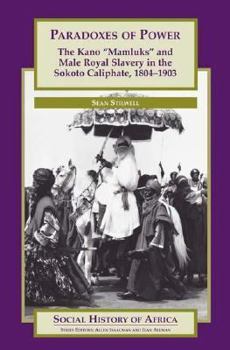
Paradoxes of Power (Social History of Africa Series)
No Customer Reviews

This book is a history of royal slavery in the Sokoto Caliphate of what is now Nigeria. Shaped by the broader literature on Islam and slavery in Africa, Stilwell's study seeks to understand the historical relationship between Islam, Islamic politics, and the use of slaves in Kano - a major city in the Caliphate. By doing this, Stilwell opens a new comparative dimension in African social history. This work integrates the history of the most important state of 19th-century Islamic Africa with the broader Islamic world. Based on highly original research, as well as extensive interviews of the descendants of slaves in Kano, this book marks a significant contribution to the literature on Islam, comparative slavery, and African history. Stilwell outlines how and why slaves acquired political power. He argues that, in this African context, slavery and power were not mutually exclusive. Contesting Claude Meillassoux's argument that slaves were by definition socially isolated and kinless "outsiders," Stilwell shows how slaves constructed family networks and took advantage of court politics to contest the terms of their subjugation. In this process, royal slaves aimed not for absolute western-style "freedom," but fought to gain access to, and in some cases redefine, the political and social system of the dominant, aristocratic culture.
Format:Paperback
Language:English
ISBN:0325070407
ISBN13:9780325070407
Release Date:April 2004
Publisher:Heinemann
Length:296 Pages
Weight:6.30 lbs.
Dimensions:9.2" x 0.9" x 6.1"
Customer Reviews
0 rating
Copyright © 2025 Thriftbooks.com
Terms of Use | Privacy Policy | Do Not Sell/Share My Personal Information | Cookie Policy | Cookie Preferences | Accessibility Statement
ThriftBooks ® and the ThriftBooks ® logo are registered trademarks of Thrift Books Global, LLC
ThriftBooks ® and the ThriftBooks ® logo are registered trademarks of Thrift Books Global, LLC
