


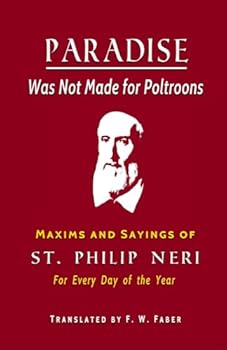
Paradise was Not Made for Poltroons: Maxims and Sayings of St. Philip Neri
No Customer Reviews

St. Philip Neri would say, "the cheerful are much easier to guide in the spiritual life than the melancholy." And as testimony to the good success of St. Philip Neri's spiritual direction, St. Alphonsus Liguori writes: "when St. Philip Neri died and went to Heaven, the Lord sent to meet him all the souls that he had saved." How many souls were there to greet this "Second Apostle of Rome?" We will have to wait to find out the answer. Nevertheless, it was undoubtedly the virtue of humility that he helped to inculcate into his penitents which resulted in the presumably large number. One of the Saint's favorite lessons was this: "Love to be unknown and to be regarded as nothing." Hence, fearing that his disciples would make haste to use his writings after his death in order to see him canonized, the future Saint---in an act of humility---burned them! Thankfully, for us, those who knew him assembled together their recollections of his teachings, which were later published as "Ricordi e Detti di San Filippo." Many years later, Fr. F. W. Faber translated that publication into English, which provides the basis for the three hundred and sixty-six spiritual meditations contained in this book. A little more on St. Philip: "Well brothers,'' he would say, "when shall we begin to do some good?'' Despite the fact that holiness begets good works, the Saint knew that it is necessary for all those who walk the path of holiness never to believe that they have done any good: "A man ought never to think he has done any good, or rest contented with any degree of perfection he may have attained, because Christ has given us the type of our perfection, in putting before us the perfection of the Eternal Father. 'Be ye perfect, even as your Heavenly Father is perfect.'" ( March 3) Moreover, he instructs us, that "God takes especial delight in the humility of a man who believes that he has not yet begun to do any good." (September 12) Therefore, in a spirit of detachment, he exhorts us to do good every day: "Do not let a day pass without doing some good in it." (January 2) As for self-praise, we are admonished that "A man ought never to say one word in his own praise, however true it may be, no, not even in a joking way." (July 4) He also spoke of many other things in order that we may make progress in the spiritual life; but humility was the root of it all; that is, humility practiced in a cheerful manner. (In the case of St. Philip Neri, this also included a holy sense of humor.) But alas, so little is left to us from the writings of this great Saint. Therefore, we offer this little book of three hundred and sixty six of his spiritual maxims in order that we too, some four hundred years after his death, may receive, at least in part, the benefits of his spiritual direction. After all, as St. Alphonsus assures us, he was quite successful in guiding many others to Heaven. So, "let us learn here below to give God the confession of praise which we ought to hope to give Him in Heaven above," as the Saint exhorts us (October 6); and take heart, that ''we have no time to go to sleep here, f or Paradise was not made for poltroons.'' (August 6) In order to facilitate the good effects of each of these salutary directives from the spiritual direction of St. Philip Neri, we present each of them on its own page.
Format:Paperback
Language:English
ISBN:B0DR74VP78
ISBN13:9798304419628
Release Date:December 2024
Publisher:Independently published
Length:386 Pages
Dimensions:6.4" x 1.0" x 4.1"
Customer Reviews
0 rating
Copyright © 2026 Thriftbooks.com Terms of Use
| Privacy Policy | Do Not
Sell/Share My Personal Information | Cookie Policy | Cookie Preferences | Accessibility Statement
ThriftBooks® and the ThriftBooks® logo are registered trademarks of Thrift Books Global, LLC
ThriftBooks® and the ThriftBooks® logo are registered trademarks of Thrift Books Global, LLC
