


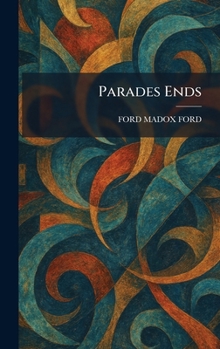
Parades Ends

"Parade's End" is a monumental tetralogy that stands as one of the most profound literary explorations of World War I and the shifting social landscape of early 20th-century Britain. Through the life of Christopher Tietjens, an aristocratic government statistician known as "the last English Tory," Ford Madox Ford weaves a complex narrative of personal integrity, betrayal, and the psychological toll of global conflict.
The work masterfully captures the transition from the stability of the Edwardian era to the chaos and disillusionment of the post-war world. Spanning from the trenches of the Western Front to the drawing rooms of London, the narrative explores the intricate dynamics of a failing marriage, the constraints of social morality, and the devastating impact of total war on the human psyche. Ford's innovative use of modernist techniques, including stream of consciousness and nonlinear storytelling, places this series at the forefront of 20th-century literature.
A masterpiece of historical fiction and psychological depth, "Parade's End" remains an essential chronicle of a generation caught between the traditions of the past and the uncertainty of a modern future. It is a sweeping epic that examines how individuals maintain their honor and identity in a world that is irrevocably changing.
This work has been selected by scholars as being culturally important, and is part of the knowledge base of civilization as we know it. This work was reproduced from the original artifact, and remains as true to the original work as possible. Therefore, you may see the original copyright references, library stamps (as most of these works have been housed in our most important libraries around the world), and other notations in the work.
This work is in the public domain in the United States of America, and possibly other nations. Within the United States, you may freely copy and distribute this work, as no entity (individual or corporate) has a copyright on the body of the work.
As a reproduction of a historical artifact, this work may contain missing or blurred pages, poor pictures, errant marks, etc. Scholars believe, and we concur, that this work is important enough to be preserved, reproduced, and made generally available to the public. We appreciate your support of the preservation process, and thank you for being an important part of keeping this knowledge alive and relevant.
Customer Reviews
ThriftBooks ® and the ThriftBooks ® logo are registered trademarks of Thrift Books Global, LLC
