


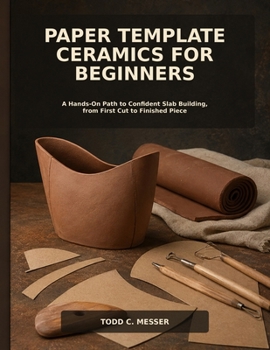
Paper Template Ceramics for Beginners: A Hands-On Path to Confident Slab Building, from First Cut to Finished Piece

Slab pottery can look simple on paper, then fall apart when the clay stretches, seams open, rims warp, or a finished piece fires smaller than expected. If you have ever traced a pattern and still wondered why the ceramic form did not match it, this book gives you the missing connection between flat design and real clay behavior.
You will learn how to design, test, transfer, assemble, dry, fire, and refine paper-template forms with a repeatable method. Instead of depending on isolated downloadable patterns, you will understand why the geometry works and how to adjust it for your clay, your firing process, and the finished size you actually want.
Inside, you'll find:
- Build stronger foundations by choosing suitable clay, slab thickness, tools, work surfaces, and moisture stages for template construction.
- Design reusable patterns by turning cylinders, tapered vessels, boxes, bowls, lids, handles, spouts, and feet into workable flat components.
- Control finished dimensions with practical shrinkage testing, scaling calculations, printer checks, and repeatable studio records.
- Reduce warping by rolling in multiple directions, compressing both slab faces, supporting soft forms, and drying broad surfaces evenly.
- Create durable joins by matching moisture, fitting edges accurately, scoring and slipping appropriately, compressing seams, and reinforcing only where needed.
- Plan surface decoration before assembly so texture, carving, slip, and underglaze work with seams instead of weakening them.
- Practice through twelve progressive projects including trays, cups, mugs, vases, planters, lidded boxes, pitchers, platters, and sculptural forms.
- Diagnose failures systematically by separating pattern errors from construction, drying, glaze, and firing problems before revising the next build.
- Work more safely with clear attention to clay dust, cutting tools, kiln ventilation, studio cleanup, and functional-ware considerations.
This book is for beginning and early-intermediate potters who want to build wheel-free ceramic forms from paper or card patterns, whether they work in a home studio, class, community ceramics center, or shared kiln space. It is especially useful for makers who want to progress from tracing templates to designing and correcting their own.
Start with paper, learn what the clay is telling you, and build a pattern library that gets more accurate with every firing.
Customer Reviews
ThriftBooks ® and the ThriftBooks ® logo are registered trademarks of Thrift Books Global, LLC
