


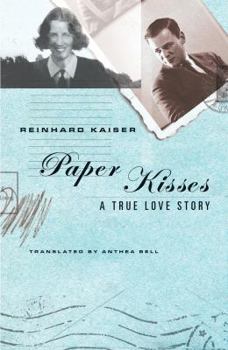
Paper Kisses: A True Love Story

A fascinating piece of literary detective work about star-crossed lovers in Nazi Germany. Rudolf Kaufmann, a young Jewish geologist, met Ingeborg Magnusson, a young Swedish woman gifted in languages,... This description may be from another edition of this product.
Format:Paperback
Language:English
ISBN:1590511816
ISBN13:9781590511817
Release Date:May 2006
Publisher:Other Press
Length:128 Pages
Weight:0.35 lbs.
Dimensions:8.2" x 0.4" x 5.5"
Customer Reviews
1 rating
Little Wife and Little Husband
Published by Thriftbooks.com User , 19 years ago
As an American boy growing up in France, we played a board game called "Little Horses" (Petits Chevaux), sometimes called the Dada game. My parents called this game, Parcheesi, which we thought a "cheesy" monicker. In Reinhard Kaiser's PAPER KISSES, a true story of lovers from different nations parted by German state totalitarianism, Rudolf the hero plays endless games of "mensch argere dich nicht" in Coburg prison to keep busy while his sentence stretches outward and onward, and the author reveals that this game is "a traditional German board game a little like ludo, but the title means, 'Don't get annoyed!'" I hadn't realized that "parcheesi" was the US name for the British game ludo. Funny the things that cross your mind reading a homely, understated, yet ultimately tragic beyond belief book like Reinhard Kaiser's PAPER KISSES. It all began when the author bid on some stamps at a Berlin auction about 15 years ago, and the stamped envelopes, he discovered, all had the original letters inside. Sounds like a novel, doesn't it? Well fasten your seatbelts everyone, you're about to enter the tunnel of love, Third Reich style. Anthea Bell's translation is generally speaking, a sensitive and persuasive one, getting across the subtle differences between Kaufmann's style as manifested in the letters, and Reinhard Kaiser's very close third person narration, in which he seems often to be paraphrasing directly from the correspondence, perhaps adding here and there with little bits of info he picked up from outside sources (there's a brief bibliography at the back of the book which gives an idea of how extensive Kaiser's research must have been). The book is so gracefully written, it's like watching Katarina Witt skate on ice, and yet, what a dangerous feat when you think of it and the whole enterprise could have landed in a flying heap of "poignancy" or "nostalgia" or what have you. It reads like a novel, and yet, what do we mean when we attempt to praise a work of history like this one with those words? As Kaiser reveals, he thought of turning the story of Rudolf and Inge into a novel, where he could manipulate the material in whichever direction he chose, and then he discovered that something intrinsic resisted this manipulation. It wasn't a perfect love story by any means, was it, for Rudolf's own sex drive got him into trouble (indeed, put him into prison for three years), and then eventually killed the love affair entirely when he met yet another woman during the years of exile in Lithuania. Inge seems more faithful, and yet, we don't have her side of the correspondence (bar one draft of a Christmas letter in which she seems to be playing Patient Griselda, a very sweet letter as it happens) so she seems more shadowy. He's so real I can almost imagine him living today: a good looking ladies' man and scientist, whose Jewish blood, never in any sense a real part of his identity, becomes more and more real to him as the book progresses and h
Copyright © 2026 Thriftbooks.com Terms of Use
| Privacy Policy | Do Not
Sell/Share My Personal Information | Cookie Policy | Cookie Preferences | Accessibility Statement
ThriftBooks® and the ThriftBooks® logo are registered trademarks of Thrift Books Global, LLC
ThriftBooks® and the ThriftBooks® logo are registered trademarks of Thrift Books Global, LLC
