


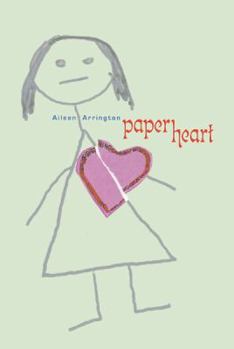
Paper Heart

A girl must find a way to lead a normal life despite her overbearing mother in this Society of School Librarians International Honor Book. On cold days Nadia isn't allowed to play outside at recess... This description may be from another edition of this product.
Format:Hardcover
Language:English
ISBN:1932425616
ISBN13:9781932425611
Release Date:October 2006
Publisher:Front Street, Incorporated
Length:116 Pages
Weight:0.65 lbs.
Dimensions:8.3" x 0.8" x 5.8"
Age Range:6 to 9 years
Grade Range:Grades 3 to 4
Customer Reviews
2 ratings
Hearts are more than paper cutouts....
Published by Thriftbooks.com User , 17 years ago
Nadia's father died of a heart attack when she was five. Her mother told Nadia that she had the same condition, and kept Nadia sequestered all of her life. Now in sixth grade, Nadia has no friends, no activities, and the bleak outlook of being further isolated by being home schooled. Her slightest cough has her mother putting to bed. Sometimes in school, Nadia gives up as well and puts her head on her desk--after all, no one expects anything from the sick girl. She tries out for the school play, does a brilliant audition and is devastated when she doesn't get the part. She finds out later that her mother told the teacher not to allow Nadia to participate. Nadia is old enough now to raise questions, and, with typical coming-of-age surging of independence, to rebel against her parent. She finds out, by virtue of being in a position to read her medical chart at the doctor's office, that she is perfectly fine, a slight heart murmur notwithstanding. This encourages Nadia to take her life back to herself. Some reviewers have felt the narrator's voice to be unsympathetically whiny, but it is perfectly well-drawn for a child who was treated as sickly her whole life. Who wouldn't be whiny? This is a well-done chyrsalis-to-butterfly story--the larval stage being neither understood nor revered by most onlookers.
Courtesy of Teens Read Too
Published by Thriftbooks.com User , 19 years ago
Nadia really does want to play with the other kids. She is tired of playing with paper dolls. But her overprotective mother will not allow her to do anything that will put her fragile heart at risk; i.e. anything that could help her make real friends--running, jumping, rolling around on the forbidden sawdust pile. Besides, the paper dolls have never laughed at her. They have never pointed at her or called her "the sick girl." Still, as she plays with her dolls, despite her mother's constant warnings to the contrary, it occurs to Nadia that she does not wish to allow fear to dominate her life: "Paper dolls. Paper books. Paper cards. Paper life" (p. 85). So, Nadia devises a plan. She will become an actress. She will secure the lead in the sixth-grade play, and then she will be someone everyone will want to know. She won't tell her mother, of course, and by the time Mrs. Riley knows that the little white lies she has told to get the role are, well, not the complete story, no one will be angry with her because she will have shown them all that she does indeed have value beyond being a source of constant worry for her mother and a target for teasing for the kids at school. Arrington does an excellent job of exploring the problems that arise when a parent becomes overprotective of a child with a medical condition. Additionally, the unexpected twist she includes is a welcome breath of fresh air in this reviewer's opinion. It is entirely credible, but keeps the storyline from becoming predictable. Nadia's quest to be more than just "the sick girl" becomes a journey for both her and her mother, and it is one that the reader will be glad she has taken, as well. Reviewed by: Mechele R. Dillard
Copyright © 2026 Thriftbooks.com Terms of Use
| Privacy Policy | Do Not
Sell/Share My Personal Information | Cookie Policy | Cookie Preferences | Accessibility Statement
ThriftBooks® and the ThriftBooks® logo are registered trademarks of Thrift Books Global, LLC
ThriftBooks® and the ThriftBooks® logo are registered trademarks of Thrift Books Global, LLC
