


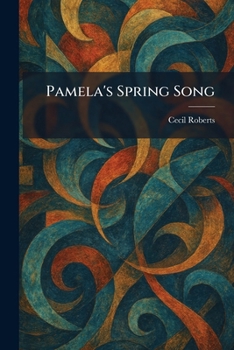
Pamela's Spring Song

Select Format
Select Condition 
Book Overview
"Pamela's Spring Song" is a charming and evocative romantic novel that captures the spirit of adventure and the longing for beauty in the early twentieth century. The story follows Pamela, a diligent but bored London secretary whose life is transformed by a simple travel poster. Seizing a moment of impulsive courage, she uses her modest savings to escape the grey skies of England for a transformative journey to the sun-drenched landscapes of the Tyrol in Austria.
Cecil Roberts masterfully blends travelogue with romance, painting a vivid picture of Central Europe in the late 1920s. As Pamela navigates her way through alpine meadows and historic towns, she encounters a colorful cast of characters and discovers that life holds far more possibilities than her office desk in London ever suggested. With its lyrical prose and optimistic outlook, "Pamela's Spring Song" remains a delightful exploration of the joy of travel and the courage required to pursue one's dreams. This work stands as a testament to the escapist literature of its era, offering readers a window into a world of elegance, discovery, and the timeless magic of a spring awakening.
This work has been selected by scholars as being culturally important, and is part of the knowledge base of civilization as we know it. This work was reproduced from the original artifact, and remains as true to the original work as possible. Therefore, you may see the original copyright references, library stamps (as most of these works have been housed in our most important libraries around the world), and other notations in the work.
This work is in the public domain in the United States of America, and possibly other nations. Within the United States, you may freely copy and distribute this work, as no entity (individual or corporate) has a copyright on the body of the work.
As a reproduction of a historical artifact, this work may contain missing or blurred pages, poor pictures, errant marks, etc. Scholars believe, and we concur, that this work is important enough to be preserved, reproduced, and made generally available to the public. We appreciate your support of the preservation process, and thank you for being an important part of keeping this knowledge alive and relevant.
Customer Reviews
ThriftBooks ® and the ThriftBooks ® logo are registered trademarks of Thrift Books Global, LLC
