


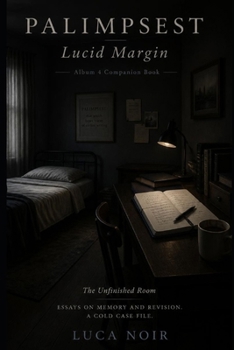
PALIMPSEST — Lucid Margin

Lucid Margin is a companion book built like a case notebook: short entries, sharp details, and the accumulating pressure of a story that refuses to resolve.
Across nine tracks and a series of tightly written chapters, Luca Noir (PALIMPSEST, Album 4) explores what happens in the white space where memories are revised, crossed out, and written over again. This is not a codex-length treatise. It is a margin book - deliberately brief, deliberately unfinished, and structurally honest about what it cannot conclude.
Part I, The Open Case, stays close to the music. Each chapter tracks one song from the Lucid Margin record:
starting a record before you know what you are recording,
the lucid state between sleep and revision,
erased paragraphs and overwritten lines,
the quiet weight of all the versions of you that never made the final document.
Interstitials read like field notes: single-page meditations on LUCID, MARGIN, REVISION, DRAFT, ARCHIVE.
Part II, The Case Continues, goes further. It introduces a fictional cold case called The Unfinished Room, told entirely through a detective's notebook. A young woman disappears from a bedroom left mid-act: bed made but not smoothed, notebook open, pen laid across a half-finished sentence. The official file calls it a voluntary disappearance and stamps it Cleared (Administrative Closure). The notebook disagrees.
Through chapters like Case File: Three, Half-Awake Questions, The Notebook Does Not Conclude, and Something Larger, Off the Edge, the detective rereads a closed file at 2 a.m., tracing:
missing pages and withdrawn tapes,
witnesses whose versions protect them as much as they describe her,
tidy institutional stories that work better for the archive than for the truth.
The result is not a sensational "true crime" reveal, and not an academic autopsy. It is a philosophical noir about false resolutions: the elegant explanations we accept because they let us stop looking. Instead of offering a final answer, Lucid Margin treats unfinishedness as a legitimate state. It records missing information as evidence, doubt as data, and honest suspension as a better ending than a comforting lie.
Appendices extend the PALIMPSEST lexicon with new terms for this territory (for the lucid threshold, the returning question, the elegant-but-unusable answer), offer brief track notes in the same analytic register, and situate Lucid Margin inside the wider Dark Sacred / PALIMPSEST arc.
This book will appeal to readers who like:
experimental crime and detective fiction told through notebooks and case files,
philosophical essays on memory, revision, and identity,
hybrid projects where music, prose, and worldbuilding interlock.
If you have ever stood in the doorway of your own life and felt that something important was happening just off the edge of the page, Lucid Margin is written from there. It does not pretend to solve that feeling. It takes it seriously enough to write it down.
MORS NON IMPERABIT.
Customer Reviews
ThriftBooks ® and the ThriftBooks ® logo are registered trademarks of Thrift Books Global, LLC
