


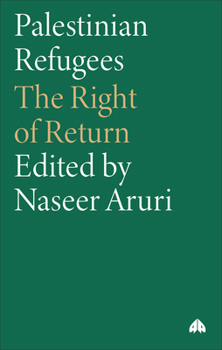
Palestinian Refugees: The Right of Return: The Right of Return

Select Format
Select Condition 
Book Overview
With renewed conflict in the Middle East, the prospect of a peaceful resolution looks more unlikely than ever. The Palestinian right of return to their homes has been upheld in international law and through United Nations' resolutions for fifty years. Equally the right of return has been denied by Israel and deferred to a "final status" issue in the Oslo Accords. It is on this right of return that the Palestinians are united. And it is this issue which is so frequently ignored by the international media.
With major contributions from a range of international experts, including Edward W. Said, Noam Chomsky, Ilan Pappe, Alain Gresh and Norman Finkelstein, this volume examines the Palestinians' right of return. Chapters cover the historical roots of the Palestinian refugee question; the rights of the refugees under international law; the special case of Lebanon; Israeli perceptions of the refugee question; the practical feasibility of the return; the role of the United States and the European Union and the Refugee Question; the value of the refugee property; the principles of compensation; and a programme for an Independent Rights Campaign.Format:Paperback
Language:English
ISBN:0745317766
ISBN13:9780745317762
Release Date:September 2001
Publisher:Pluto Press (UK)
Length:312 Pages
Weight:0.88 lbs.
Dimensions:0.7" x 5.3" x 8.5"
Customer Reviews
5 ratings
Clear, fair and balanced approach to Palestinian plight
Published by Thriftbooks.com User , 22 years ago
Many will unfairly denounce this book simply for virtue that it does not show Israel in a purely positive light. However, this book is well-timed as it contains much revisionist history about the Arab-israeli conflict. For example, the Israeli government in 2002 finally declassified documents that showed that the Mossad funded and helped create Hamas to destabalize the PLO and fragment the Palestinians with a "homegrown, religious alternative." Shimon Peres has come forward and testified to this and it is undisputed fact. This book in no way favors the Palestinians. It gives equal time to discussing the sycophantic leaders who have allowed Arafat to stay in power and disrupt the peace process at nearly every turn. The main purpose of this book, though, is to provide a clear argument for the sake of evaluating the possibility of the refugees returning to their lands in Israel. It discusses very eloquently through several articles how such a return would actually work to the advantage of both the Israeli and Palestinian peoples. This book is a major-policy read, so you won't find much propaganda. This book is not for the lightly attentive. There are many details and a lot of governmental and diplomatic language involved. Not for the light reader. This book also contains one of the last articles that renowned academic and Nobel Peace Prize winner Edward Said wrote before he lost his battle to lukemia this past year. Edward Said was most noted as the man who propounded the theories of Orientalism and Occidentalism. If you wish to gain a better understanding for what viable options there are to solve the current Arab-Israeli conflict, read this book.
The Palestinian case
Published by Thriftbooks.com User , 23 years ago
Nur Masalha in chapter 2 writes that Plan D was implemented in early 1948, officially implying the clearing and expulsion of Palestinian villages and villagers. Maslah goes through some of the 100 or so massacres by the Hagannah. For example he quotes the account of soldiers in Moshe Dayan's batallion about the massacre of 80-100 people at Al-Dawayma in October 1948. Safsaf, Oct. 1948, several dozen men dumped in a well and shot; hundreds massacre by Palmach, elite strike force of Hagannah, then hundreds more in forced march of inhabitants to Arab army lines; 70 Arab detainees massacred May 1948 at Ayn Zaytun. Hula, October 1948, Shmuel Lahis murdered perhaps up to 80 villagers he was gaurding in this Lebanese village (Masalha does not mention that Lahis later became secretary general of the Jewish agency and was amnestied after recieving a seven year prison sentence for this crime and was given a liscence to practice law by the Israeli legal council on the ground the his act carried no stigma). Masalha writes this to show that massacres were a big part of the policy of the mainstream Hagannah; not simply those of the "dissident" Irgun and Stern Gang. Masalha continues with a discussion of the explusion of thousands of Azame tribesmen from 1949 to 1956. He notes that Northern commander Yitzhak Rabin, which like his role in the Lydda and Ramle expulsion of 1948 as Palmach commander, he recounted in his memoirs his using the cover of the Suez war in October 1956 to expel thousands of Israeli Arabs in Northern Israel to Syria. It happened one day after the Kafr Qassem massacre. Wadie Said discusses the abysmal treatment of Palestinian refugees in Lebanon, where they have little chance of employment or getting the social services given to other Lebanese. They must even build their houses in their camps in ramshackle manner so as not to make them permanent. The reason given is that the government insists that the they don't want to give up the Palestinian right of return to their homes in Palestine by integrating them into their society but they are more likely actually concerned about tipping the precarious confessional balance in favor of Sunni Muslims. Said gives an instructive incident from September 1995, when Gadaffi expelled all Palestinian workers from Libya as a way of protesting the peace process but the Lebanese government insisted those coming from Lebanon couldn't return but had to reapply for a passport even though Lebanese law said they didn't need to. Noam Chomsky that the U.S. supported Israel's rejection of Sadat's offer to recognize Israel in return for the Sinai in February 1971. When the Arab states and the PLO supported a resolution in January 1976 calling for adding a Palestinian state to resolution 242, promising to let Israel live in peace and security, the U.S. vetoed it but a month before Israel had engaged in a "preventive" bombing of Beirut, killing 57 civillians in Beirut to let the security council know what it though
A Just and Compelling Argument
Published by Thriftbooks.com User , 24 years ago
This work clearly demonstrates the legality of the right of return of Palestinian refugees, as well as the moral and ethical case for such a return. It outlines clearly how the problem of the Palestinian refugees was created - by forced eviction at the gunpoints of Zionist terrorist units, the leaders of which later became many of Israel's prime ministers - and explains, through detailed examination of the historical record and of international law, the sense of justice that a right of return would create in the international community.This crucial issue, which has always been at the soul of the current conflict over Israel/Palestine, is usually overlooked in American news analyses. This book brings the issue to the fore with compelling intellectual force. No person concerned with justice, be he Jew (as I am) or Arab or of other origin, can afford to ignore it.Yossef LevinsteinIsrael
A compelling historical, human, and legal case
Published by Thriftbooks.com User , 24 years ago
This excellent, scholarly volume presents the most comprehensive coverage to date of the various aspects of the Palestinian refugee issue. Its sixteen contributors--American, Arab, and Jewish intelectuals--provide in depth research and analysis under four headings: (1) the historical context, (2) the interests of the major actors, (3) return or permanent exile, and (4) refugee claims and the search for a just solution. The volume is extremely timely as the refugee issue is one of the major questions in the "final status" talks mandated by the 1993 Declaration of Principles that is the legal framework for the entire Oslo peace process. (One must hope that the past year of Israeli-Palestinian conflict will be resolved and that negotiations for a final settlement will be rsumed.) The book is of added importance, coming in the wake of research by numerous Israeli scholars (Benny Morris, Avi Shalim, Ilan Pappe, Zeev Sternhell, Simha Flapan, Tom Segev, & others), who have conclusively demonstrated Israel's planned, organized, and implemented strategy for removing the Palestinians. All have illustrated that in its quest to have a "Jewish State," the Haganah and other forces undertook a systematic campaign of ethnic-cleansing that created the refugee issue. Aruri's book then, provides a bridge between Israeli responsibility for creating the original refugee situation and its responsibility today for resolving it in a just manner. "Palestinian Refugees" makes a compelling historical, human, and legal case for the Palestinian right of return. The volume is an excellent source for those engaged in research on the issue; for graduate and undergraduate students; and for policy makers and practioners. I highly recommend it.
pro palestinian
Published by Thriftbooks.com User , 24 years ago
I have read many topics on the issue of the Arab and Israeli Conflict and only few of them have been written as well as this book with all the facts. Personally, I enjoyed the book only because I have read numerous books with the pro-Israeli views and this is the first I have read that was pro-Palestinian. It was very interesting to see how both sides contradict each other and debate without even speaking. I also did not know much of what was happening to Palestinians thanks to American media and the lack of their portrayal of such topics, however this book was excellent in explaining such things.
Copyright © 2026 Thriftbooks.com
Terms of Use | Privacy Policy | Do Not Sell/Share My Personal Information | Cookie Policy | Cookie Preferences | Accessibility Statement
ThriftBooks ® and the ThriftBooks ® logo are registered trademarks of Thrift Books Global, LLC
ThriftBooks ® and the ThriftBooks ® logo are registered trademarks of Thrift Books Global, LLC
